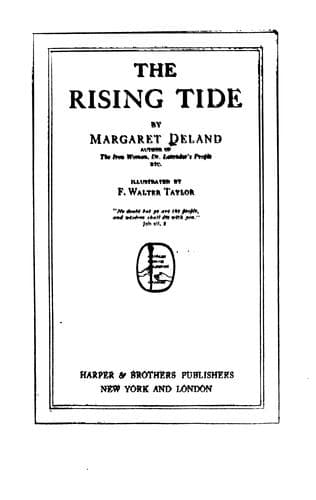
Mate selection -- Fiction; Women -- Suffrage -- United States -- Fiction; Young women -- Fiction
As the Payton house fell into somnolence, Payton Street woke up. The
air, stagnant between sun-baked brick walls, was a medley of noises that
sometimes sank to a rumbling diapason, or sometimes stabbed the ear in
single discords: the jangle of mule-bells, the bumping of the car on the
switch, the jolt of milk-wagons over the cobblestones. In the
provision-store all day long a parrot vociferated; from the
livery-stable came the monotonous pounding of hoofs, or, when Mr. Baker
sent out a hearse and some funeral hacks, the screech of grating wheels.
Hand-organs came and went. Fruit-dealers cried their
wares--"Strawberries! Strawberries! Strawb--" The ailanthus-shaded
pavements swarmed with shrill-voiced children; they summoned one another
to pull the parrot's tail or to look at the hearse; they assailed the
ice-carts, reveling in the drip from the tail-boards and sucking what
bits of ice they could scrape up. Sometimes they squabbled raucously,
sometimes wept; sometimes, hushing their betraying giggles, crept into
Mrs. Payton's front yard and climbed up on the iron dog "to play
circus"--until Mrs. Payton, always on the watch, discovered them and
sent Miss Carter down to drive them away.
Except for skirmishes with the marauding children, Mrs. Payton's days
were very placid. She worked out new puzzles and dozed through stories
in the magazines. She wrote twice a week dutiful letters to her mother,
pausing occasionally to think of something to say or to listen,
absently, to the swish of the watering-cart along the street; she liked
the wet smell of the watered cobblestones mingling with the heavy odor
of the blossoming ailanthus. There never seemed to be anything to tell
Mrs. Holmes, except that she had been dreadfully busy, and that the
"accommodating" waitress didn't keep her sink clean, and that the
barber's children were very trying. Every fine afternoon, sitting
opposite Miss Carter and Morty, she drove out to the park and home
again. Once she summoned up all her energy and went to Lakeville to
spend a day with Fred. She thought that if she didn't go, Freddy would
believe she preferred to stay with Morty. ("Oh, if I _only_ hadn't told
her I loved him best!" she used to reproach herself.) It was a bitter
thing to Mrs. Payton to pass through Laketon and see the place where a
Payton girl ought to be, "instead of living with all kinds of people in
Lakeville!" When Fred met her at the station and brought her to the ugly
little cottage--its garish interior vivid, now, with yellow
pennons--she tried, for the sake of peace, to restrain her disapproval
of everything she saw, but she couldn't help saying she wondered how
Fred could stand the solferino lamp-shade.
"Hideous," Frederica said, carelessly, "so why look at it? I never look
at our Iron Virgin."
"There is some difference in value," Mrs. Payton reproved her.
Public-domain text, read in full here on John Shaqi.
Reviews
Reviews
No reviews yet
Be the first to share your thoughts on this work.
Elsewhere in the archive
Join the Discussion
Join the discussion
Sign in to leave a comment or review.
Sign InorCreate an account