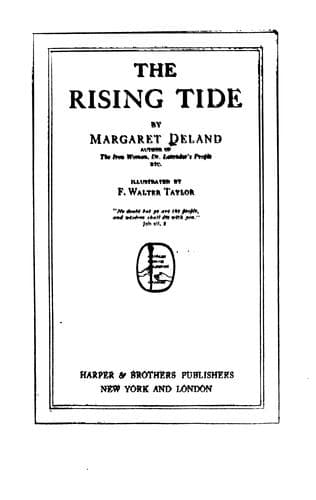
Mate selection -- Fiction; Women -- Suffrage -- United States -- Fiction; Young women -- Fiction
"No, only in cost," her daughter said; then saw the color mount into her
mother's face, and gritted her teeth. ("I needn't have said that--but
it's true! Darn it, I _am_ like him!") After that she tried to think of
something pleasant to say, but what was there to talk about?--only the
waitress, and the heat, and the barber's dirty children. Indeed, it
would have been difficult to decide which found that visit to the
bungalow the most trying, the mother or the daughter. Certainly it was a
relief to both of them when it was over.
"Mother came out to the camp and I wasn't a bit nice to her," Fred
bemoaned herself, one day, to Arthur Weston, when he met her entering
No. 15 just as he was leaving it. He turned back and followed her into
the parlor.
"And nobody can be so un-nice as you, when you put your mind on it," he
said, genially.
She laughed. "You never talk through your hat to me; you're straight.
That's why I like you."
"Then you'll like me more, for I'm going to be very straight," he warned
her. He looked about for any kind of a cool seat, but subsided into a
linen-covered feather-bed of a chair, close to the bust of Mr. Andrew
Payton; his eye-glasses on their black ribbon dangling in a thread of
sunshine, sent faint lights back and forth on the ceiling. "Life is very
dull for your mother," he said, fanning himself with his hat; "why don't
you come in oftener?"
Frederica, on the piano-stool, struck a careless octave. "Life dull?
Why, I think it's wildly exciting! As for coming in, I'm too busy."
"Reforming the world? You might begin the reformation by making things
happier here. Happiness is a valuable reformatory agent. You could cheer
Mrs. Payton up, but you prefer 'being busy.'"
Fred colored. He had spoken to her once before in this same peremptory
way, and she had been angry; now she was embarrassed. "I'm on my job.
I've started a suffrage league--"
"There are other people who can start leagues. There is only one person
who can make your mother happy."
"Mr. Weston, the relative value of picture puzzles and the emancipation
of women--"
That made him really indignant; he stopped fanning himself and looked at
her with hard eyes. "The doing of the immediate duty by each individual
woman will emancipate the sex a good deal quicker than talking! You
needn't stop your suffrage work to do your duty as a daughter. Did you
ever hear anything about bearing one another's burdens?"
"Sounds like the Bible," Fred said.
"It is. I commend the book as a course in sociology."
"But," she defended herself, "I _do_ come home quite often. I'm going
to be here to-night. I'm going to a dinner dance at the Country Club,
and I'm coming back here to stay all night."
Public-domain text, read in full here on John Shaqi.
Reviews
Reviews
No reviews yet
Be the first to share your thoughts on this work.
Elsewhere in the archive
Join the Discussion
Join the discussion
Sign in to leave a comment or review.
Sign InorCreate an account