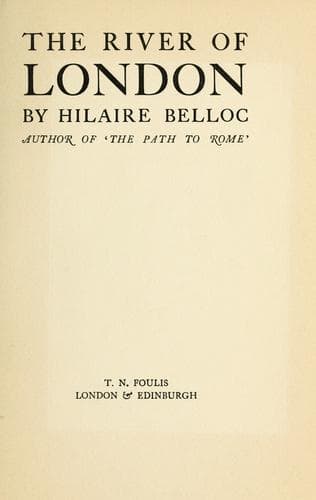
London (England) -- Description and travel; Thames River (England)
A generation ago it was universal, and there was no phenomenon in the
story of England or of Europe from the emplacement of a city to the
growth of the Church which was not traced to inanimate causes superior
to, and independent of, any action of the Will. This philosophy
narrowed, distorted, and dried up every department of knowledge, and
while the area of learning increased with a rapidity hitherto unknown,
the spirit inhabiting that conquest was starved. It was as though
the time could not contain at once the energy to discover and the
energy to know, and as though the covering of so vast a field in so
short a period was achieved inevitably at a cost of profundity. That
a bias towards the mechanical and the necessary should be present in
the physical sciences--in chemistry for instance--is to be expected,
that it should have invaded biology was less excusable, but that it
should have been permitted to affect (as it did) the business native to
man--his building, his institutions, his very dreams--was an excessive
blunder, and the spirit of all the younger men to-day is running if
anything too strongly in reaction against that ebb-tide of the soul.
They reject the dogmas of their fathers which would bend everything
man has done to material circumstance, which would talk of man as
the slave rather than the master of his instruments, and which, in
an argument absurdly circular, “interpreted history in the terms of
Economics”:--and they are right.
Even in the sphere of topography, where the physical limitations
of human action are the main subject of the writer, they expect a
full admission of the soul of man and even--which is very wise--some
recognition of that mysterious genius which inhabits every place and is
perhaps its vital part.
They are right. No one can see the marriage between London and its
river without wondering in what degree things other than ponderable
and measurable things may enter into the habitation of man. There is
nothing man does, of course, which has not in it the soul. But it may
be also true that there is nothing done to man wherein some soul is not
also. Now the homes of man and the air and the water and the wind and
the earth, against which in part and with which in part those homes
arise, are so woven in with his fate--which is a spiritual fate--that
we must properly lend to these insensate things some controlling
motive; and we may rightly say, though only by the use of metaphor,
that all these things have a spirit within them. I cannot get away
from it that the Thames may be alive, and London most certainly is.
But all these things, though one may put them in the form of
statements, are really questions; and questions to which no sort of
answer has yet been discovered.
II
THE APPROACH UP RIVER
There is perhaps no journey in the world in which the past and what now
is and the links between them stand out more clearly stratified than a
journey up the Thames upon the tide from the Sea-reach to the Pool.
Public-domain text, read in full here on John Shaqi.
Reviews
Reviews
No reviews yet
Be the first to share your thoughts on this work.
Join the Discussion
Join the discussion
Sign in to leave a comment or review.
Sign InorCreate an account