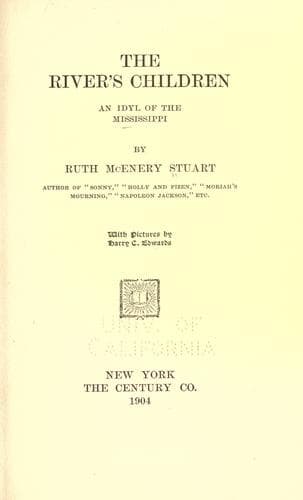
The River's Children: An Idyl of the MississippiStuart, Ruth McEnery
General
The River's Children: An Idyl of the Mississippi
Stuart, Ruth McEnery
African Americans -- Fiction; Conduct of life -- Fiction; Mississippi River -- Fiction; Poverty -- Fiction
"Dat's right, honey--ol' 'oman--dat's right. _You_ pray an' _I'll_
pray--an' we'll _watch_ wid _faith_. An' ef Gord don't sen' Marse
Harol', He'll git a message to us some way, so we'll be guided."
The sound of a horn from across the river put an end to the
conversation. Some one was blowing for the ferryman.
"PITY you tied _Wood-duck_ up so soon to-night," said the old wife,
following Israel with her eyes as she spoke, while he rose slowly and
taking the oars down from the rafters started to the river.
In a moment the old man's answering horn sounded clear and loud in
response, and the clank of the chain as it dropped in the bow of the
skiff, followed by the rhythmic sound of the oar-locks, told his
listening mate that the ferryman was on his way.
II
Besides plying the ferry-skiff at which Israel earned odd dimes--every
day a few--he turned many an honest penny with his shrimp-nets.
The rafts of logs chained together at the landing were his, and
constituted the initial station of a driftwood industry which was
finally expressed in the long piles of wood which lay stacked in cord
measures on either side of the cabin.
The low and prolonged talk of the old people to-night had been
exceptional only in its intensity. The woman's reluctant almost despair
of a forlorn hope was pathetic indeed. Still it was but momentary. They
had gone over the same ground many times before, and fear and even
foreboding had occasionally clouded their vision in reviewing the
situation.
The woman's observation in regard to the child's growing tall was the
first suggestion to Israel's mind of the urgency of immediate relief. In
the stress of material provision, men may be forgiven if they sometimes
overlook life's abstract values.
Israel was so startled by this new thought that when he had rowed his
boat out into the clearing which the broad river afforded, he
involuntarily pressed the handles of his oars, lifting their blades from
the water, while he turned his eyes in one direction and another and
then upward. He had a hard problem to solve. Here was a great thinking
space, and yet, although he stopped for the length of several strokes,
and the night was mild and still,--although every condition was
favorable for clear thought,--his mind seemed lost in a sort of maze,
and it was only when he discovered by a familiar landmark that he was
drifting fast down-stream, only with this obtrusion of the actual, that
he rallied quickly, and with a deft stroke or two recovered his course.
And as the oar-locks measured time again he chuckled:
"I got my lesson, yas, I got my lesson. _Work!_ Dat 's my po'tion. Quick
as I gits biggoty and tries to read above my head, I goes de downward
way."
He said it aloud, to himself, and the words gave him renewed energy,
for, even as he spoke, the _Duck_, with oars for wings, plunged lightly
forward over the water to a quickened measure.
* * * * *
Public-domain text, read in full here on John Shaqi.
Reviews
Reviews
No reviews yet
Be the first to share your thoughts on this work.
Join the Discussion
Join the discussion
Sign in to leave a comment or review.
Sign InorCreate an account