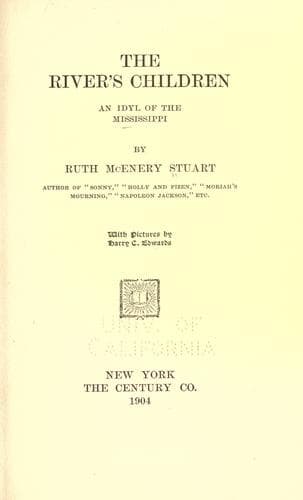
The River's Children: An Idyl of the Mississippi — John Shaqi
The River's Children: An Idyl of the MississippiStuart, Ruth McEnery
General
The River's Children: An Idyl of the Mississippi
Stuart, Ruth McEnery
African Americans -- Fiction; Conduct of life -- Fiction; Mississippi River -- Fiction; Poverty -- Fiction
When finally the party had embarked, the hostess riding in the first
boat with the governor of the State, while Harold brought up the rear
with the governor's lady, the sun was low in the west, and narrow
search-lights, piercing the wood for a brief moment, revealed a great
wonder-world of dank growths so fairly alive with creeping, flying,
darting things--chirping, calling, singing, croaking, humming, and
hooting--that when in a twinkling the light suddenly went out, many of
the women shuddered with a shrinking sense of the uncanny.
Before this intangible emotion had time to crystallize into fear,
however, each pilot who manipulated the rudder astern had drawn from
under his seat a great torch of pine and set it ablaze.
Under festoons of gray Spanish moss, often swung so low that heads and
torches were obliged to defer to them, and between flowering banks which
seemed sometimes almost to meet in the floating growths which the
dividing bows of the boats plowed under, the little crafts sped lightly
along.
Occasionally a heavy plunging thing would strike the water with a thud,
so near a boat that a girlish shriek would pierce the wood, spending
itself in laughter. A lazy alligator, sleepily enjoying a lily-pool,
might have been startled by the light, or a line of turtles, clinging
like knots to a log over the water, suddenly let go.
Streaks of darting incandescence marked the eccentric flights of a
million fireflies flecking the deep wood whose darkness they failed to
dispel; and once or twice two reflected lights a few inches apart,
suggesting a deer in hiding, increased the tremulous interest of this
super-safe but most exciting journey.
But presently, before impressions had time to repeat themselves, and
objects dimly discerned to become familiar, a voice from the leading
boat started a song.
It was a great voice, vibrant, strong, and soft as velvet, and when
presently it was augmented by another, insidiously thrown in, then
another in the next boat, until all the untutored Harvard oarsmen were
bravely singing and the dipping oars fell into the easy measure, all
sense of fear or place was lost in the great uplift of the rhythmic
melody.
At special turns through the wood ringing echoes gave back the strains.
A mocking-bird, excited by the unusual noise, poured forth a rival
disputatious song, and an owl hooted, and something barked like a fox;
but it was the great singing of the men which filled the wood.
Common songs of the plantation followed one another--songs of love, of
night and bats, of devils and hobgoblins, selected according to the will
of the leader--all excepting the opening song, which, although of the
same repertoire, was "by request," and for obvious reasons.
It was called "When de Sun Swings Low," and ran something like this:
Public-domain text, read in full here on John Shaqi.
Reviews
Reviews
No reviews yet
Be the first to share your thoughts on this work.
Join the Discussion
Join the discussion
Sign in to leave a comment or review.
Sign InorCreate an account