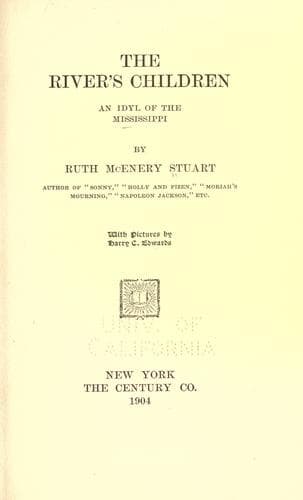
The River's Children: An Idyl of the MississippiStuart, Ruth McEnery
General
The River's Children: An Idyl of the Mississippi
Stuart, Ruth McEnery
African Americans -- Fiction; Conduct of life -- Fiction; Mississippi River -- Fiction; Poverty -- Fiction
And always there were revival meetings to which they might go and hear
dramatic recitals of marvelous personal "experiences," full of
imagery,--travels in heaven or hell,--with always the resounding human
note which ever prevails in vital reach for truth. Through it all they
discerned the cry which finds the heart of a listener and brings him
into indissoluble relation with his brother man, no matter how great the
darkness out of which the note may come. It is universal.
The call is in every heart, uttered or unexpressed, and one day it will
pierce the heavens, finding the blue for him who sends it forth, and for
the listener as well if his heart be attuned.
Let who will go and sit through one of these services, and if he does
not come away subdued and silent, more tender at heart, and, if need be,
stronger of hand to clasp and to lift, perhaps--well, perhaps his mind
is open only to the pictorial and the spectacular.
* * * * *
There is no telling how long the house-party would have remained in
Paradise but for the inexorable calendar which warned certain of its
members that they would be expected to answer the royal summons of Comus
at the approaching carnival; and of course the important fact that
certain bills from the legislature affecting the public weal were
awaiting the governor's signature.
A surprising number of marriages followed this visit, seeming to confirm
a report of an absurd number of engagements made on the island.
There is a certain old black woman living yet "down by the old basin" in
French New Orleans, a toothless old crone who, by the irony of
circumstance, is familiarly known as "Ol' Mammy Molar," who "remembers"
many things of this time and occasion, which she glibly calls "de
silveringineer party," and who likes nothing better than an audience.
If she is believed, this much too literal account of a far-away time is
most meager and unfaithful, for she does most strenuously insist that,
for instance, there was served at the servants' table on that first
night--
But let her have her way of it for a moment--just a single breath:
"Why, honey," she closes her eyes as she begins, the better to see
memory behind them. "Why, honey, de champagne wine was passed aroun' to
de hands all dat indurin' infair in _water-buckets_, an' dipped out in
_gou'd dippers-full_, bilin' over so fast an' fizzin' so it'd tickle yo'
mouf to drink it. An' Marse Harol' Le Duc, he stood on a _pi_anner-stool
on de back gallery an' th'owed out gol' dollars by de hatful for any of
us niggers to pick up; an' de guv'ner, ol' Marse Abe Lincolm, he fired
off sky-rockers an' read out freedom papers.
Public-domain text, read in full here on John Shaqi.
Reviews
Reviews
No reviews yet
Be the first to share your thoughts on this work.
Join the Discussion
Join the discussion
Sign in to leave a comment or review.
Sign InorCreate an account