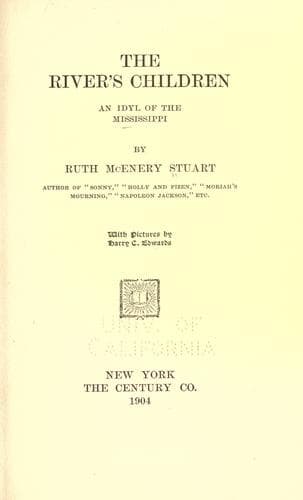
The River's Children: An Idyl of the Mississippi — John Shaqi
The River's Children: An Idyl of the MississippiStuart, Ruth McEnery
General
The River's Children: An Idyl of the Mississippi
Stuart, Ruth McEnery
African Americans -- Fiction; Conduct of life -- Fiction; Mississippi River -- Fiction; Poverty -- Fiction
"Ah, my friend, you have plenty occasion to be one good man."
"_Occasion!_ I am blessed. T'ink all I have got to be t'ankful! I got my
mudder, my mud'-in-law, my fad'-in-law--all _ril_igious people an'
good--an' _nine li'tl' one_, like six stair-steps wid t'ree landings for
de _ac_commodation of de twins." He chuckled. "Yas, an' I am going to be
good. No more dem soubrette supper for me. An' dem _danse de_--
"_Mais wait! W'at is dat?_"
A bell had rung, and a voice was calling out the depth of the water as
shown upon a graduated scale marked low down against the pier. The
announcement was half-hourly now.
"W'at he say? T'irteen inches an' a--Dat's a half-inch fall. T'ank God!
Maybe St. Joseph an' our women dey save us yet, Adolphe."
"Yas, may_be_. _Mais_ I t'ink de winter is full broke in Minnesota, too.
No more dat confoun' ice to melt. I looked _sure_ for de water to fall
down yesterday. Any'ow, one half-inch is hope. Here, take one cigar. I
can smoke, me, on dat half-inch. You got any matches, Felix?"
In finding his match-box Felix's fingers came in contact with the tiny
statue of St. Joseph in his pocket, but he was only half sensible of the
fact in his nervous joy over the slight decline in the river.
"Hello! Here is Harold Le Duc!" he exclaimed, as, by the light of his
match, he chanced to catch the presentment of a distant face in the
darkness.
"Hello! Come along, Harry, an' smoke one cigar. We mus' celebrate dat
insinuation dat de river is falling. Less dan one inch, it does not
count, except to prove she is hesitating; an' you know de ol' saying,
'She who hesitate'--'Hello, young man! You are good for sore eyes!"
The person addressed had come forward with extended hand.
When another match, lighting Adolphe's cigar, revealed the young man's
face again, there was something so startling in its wonderful solemnity
and beauty that both men were impressed.
"You won't smoke? An'w'y? Come! It is one great comfort, a li'l' smoke.
Here, let me--"
He presented the cigars again.
"Well, I thank you, but excuse me now." Young Le Duc took a cigar with a
smile. "I'll enjoy it later, maybe; but not until we see a little
further. As you say, a half-inch is only a hint, but it is a good one.
I am going now up the coast, where trouble waits, and I may need a
steady hand before morning. But I think the worst is over. Good
night--and thank you. The folks--they are all well?"
"Fine, all fine, and asking always for w'y you don't come to see dem."
But he had gone.
The eyes of both men followed the retreating figure in silence.
It was Adolphe who spoke at last.
"Ah-h-h!" he sighed. "An' yet we complain sometimes, you an' me, eh? I
am t'irty-seven years old an' I got t'irteen healt'y chillen an' two
gran'chillen, an' my wife--look at her, yo'nger an' happier wid every
one--
"Oh, I wonder, me, sometimes, dat God don't just snatch everyt'ing away
jus' for spite, w'en we always complain so.
Public-domain text, read in full here on John Shaqi.
Reviews
Reviews
No reviews yet
Be the first to share your thoughts on this work.
Join the Discussion
Join the discussion
Sign in to leave a comment or review.
Sign InorCreate an account