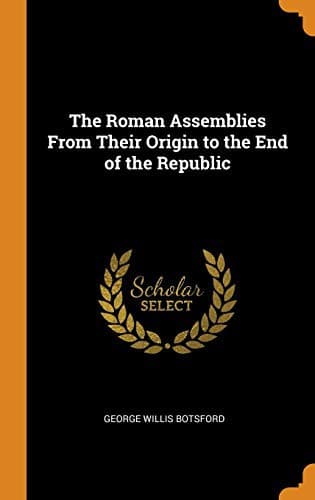
The Roman assemblies from their origin to the end of the RepublicBotsford, George Willis
History
The Roman assemblies from their origin to the end of the Republic
Botsford, George Willis
Constitutional law -- Rome; Rome -- Politics and government
negotiated, as in earlier time, by the magistrate or senate or by both
in conjunction.[1836] The details, too, of every treaty were still left
to the magistrates and senate, so that to the end of the republic the
senatus consultum continued to be indispensable.[1837] But from the time
of the Caudine misfortune, and in consequence of it, the principle was
established that a treaty involving a concession of even equal rights
on the part of Rome required the sanction of a popular vote. Recorded
instances of such ratification for this period (321-287) are rare.[1838]
The function fell to the comitia tributa under patrician or plebeian
presidency, which in its exercise showed more independence[1839] than did
the comitia centuriata in the declaration of wars. In this way the tribal
assembly took its place by the side of the centuriate in international
affairs.[1840]
The absolute power to bestow the citizenship exercised by the kings[1841]
would naturally pass undiminished to the consuls, and thence to the
censors on the institution of the latter. It is in fact the opinion of
Lange[1842] that these magistrates respectively exercised full rights in
the matter, and that they consulted the senate in important cases only.
At all events the question is simply as to the relative participation of
the magistrates and the senate in the function. The final settlement of
Latium after the war, involving the bestowal of citizenship, 338, the
senate seems to have attended to alone through a consultum, no mention
being made of the people.[1843] In the whole course of Roman history to
332 there is no record of a grant of citizenship by popular vote.[1844]
As the Acerrani were left out of account by the senatus consultum above
mentioned, L. Papirius in 332 through the first recorded pretorian law
granted them the civitas sine suffragio.[1845] In opinion of Lange,[1846]
based upon a statement of Velleius,[1847] the censors of the year, Q.
Publilius Philo and Sp. Postumius, while enrolling the new citizens,
probably obtained a senatus consultum requesting the praetor to bring
this subject before the tribes. That a senatorial decree was essential
is proved by the case of the Privernates mentioned below. We may well
believe that the great plebeian statesman Publilius gladly embraced
the opportunity to make the tribal assembly a partner in the important
function of imparting the rights of the city. Three years afterward an
order of the people, doubtless of the tribes, ex auctoritate patrum,
granted the citizenship to the Privernates, 329.[1848] By what authority
the Hernicans received the civitas sine suffragio in 306 is not
stated.[1849] Long after the Hortensian legislation the principle was
established that the people alone without the authorization of the senate
had a right to bestow the ius suffragii on whomsoever they pleased.[1850]
Logically the function should have fallen to the comitia centuriata as
Public-domain text, read in full here on John Shaqi.
Reviews
Reviews
No reviews yet
Be the first to share your thoughts on this work.
Elsewhere in the archive
Join the Discussion
Join the discussion
Sign in to leave a comment or review.
Sign InorCreate an account