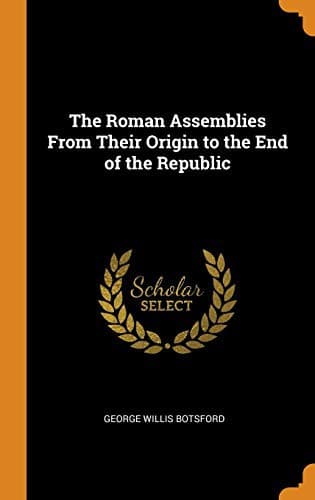
The Roman assemblies from their origin to the end of the Republic — John Shaqi
The Roman assemblies from their origin to the end of the RepublicBotsford, George Willis
History
The Roman assemblies from their origin to the end of the Republic
Botsford, George Willis
Constitutional law -- Rome; Rome -- Politics and government
2728 f.: Baebius (idem); iii.
2738-55: M. Claudius Marcellus (Münzer); iv. 1112-38: Consul
(Kübler). Grenfell, B. P., and Hunt, A. S., _Oxyrhynchus
Papyri_, iv (1904). 90-116 for the newly discovered epitome
of Livy, including text and commentary. The lost books
xlviii-lv, covering the years 150-137, are represented. See
also Kornemann, E., _Die neue Livius-Epitome aus Oxyrhynchus_,
in _Beitr. zur alt. Gesch._ Beiheft ii (1904); Sanders, H.
A., _The Oxyrhynchus Epitome of Livy_, in _Trans. of the Am.
Philol. Assoc._ xxxvi (1905). 5-31, and a brief notice by
Liebenam, W., in _Jahresb. d. Geschichtswiss._ xxvii (1904).
124 f.
CHAPTER XVI
COMITIAL LEGISLATION FROM THE GRACCHI TO SULLA 134-82
I. _The Gracchi_
134-122
The work of agrarian reform, after the feeble attempt of Laelius,[2240]
was taken up in a more determined spirit by Ti. Sempronius Gracchus,
who early in his tribunate, upon which he entered December 10, 134,
promulgated his famous lex agraria. It was a repetition, with some
modifications and additions, of those articles of the Licinian-Sextian
statute which related to the same subject. The last instance of the
prosecution of trespassers against the earlier law given in our imperfect
records belongs to 193,[2241] and it must still have been in force in
167 when Cato[2242] recited its terms in his “Oration in behalf of the
Rhodians.” Probably about the time of Flaminius the agrarian provisions
of this statute were renewed with the addition of articles, (a) providing
that a specified proportion of free laborers should be employed on public
lands held in possession. (b) requiring holders to take an oath to obey
the law. (c) increasing the penalty for violations.[2243]
Tiberius had matured his plan before entering office. Assisted by
experienced friends, among whom were P. Licinius Crassus, P. Mucius
Scaevola, the most eminent jurist of his generation, consul designate
for 133, and Appius Claudius Pulcher, his father-in-law, he expressed
the articles of his rogation in the most careful terms and with especial
regard for vested interests.[2244] Its chief provisions were—
(1) No one shall hold more than five hundred iugera of the public land,
excepting that in case the holder has sons he may occupy an additional
two hundred and fifty iugera for each of two sons.[2245]
(2) The occupier shall receive compensation for improvements on the lands
which the law compels him to surrender.[2246]
(3) The five hundred to one thousand iugera retained by the occupier
shall be granted to him by the state in perpetuity and free from all
dues.[2247]
Public-domain text, read in full here on John Shaqi.
Reviews
Reviews
No reviews yet
Be the first to share your thoughts on this work.
Elsewhere in the archive
Join the Discussion
Join the discussion
Sign in to leave a comment or review.
Sign InorCreate an account