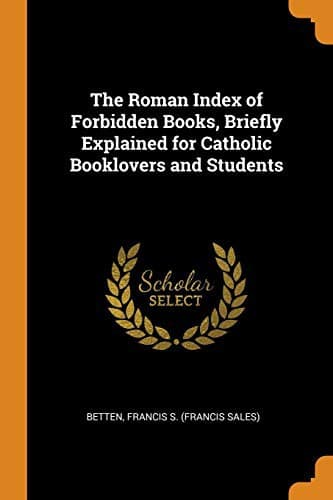
The Roman Index of Forbidden Books: Briefly Explained for Catholic Booklovers and StudentsBetten, Francis S. (Francis Sales)
Religion
The Roman Index of Forbidden Books: Briefly Explained for Catholic Booklovers and Students
Betten, Francis S. (Francis Sales)
Index librorum prohibitorum; Prohibited books
I know of a priest who was in every way a model man. He fell suddenly
away from the Church, married, and is now a foremost champion in the
ranks of the enemy. His apostasy is, not without reason, attributed to
the reading of infidel books, though no doubt he had the necessary
dispensation.
There was another priest, who has meanwhile died the death of the
just, a celebrated author and art critic. In writing a work on
Voltaire he had to study the books of that arch-agnostic. He obtained
the requisite permission, but, while perusing Voltaire’s writings, he
was on his knees, to implore, as it were, by this humble posture the
protection of God against the wicked influence to which he was
exposed.
St. Francis of Sales, the great and learned Bishop of Geneva, had
obtained permission to read the books of heretics in order to refute
them, and he is careful to let his readers know the fact, at the same
time thanking God in pathetic words that his soul had suffered no harm
in so great a danger.
This grave natural duty in the choice of our reading matter extends
much farther than the legislation of the Church. Parents and priests
do not comply with their obligation of controlling the reading of
their charges if they merely look up the Index to see whether a
certain book is mentioned there. If an otherwise unobjectionable book
contains an obscene passage of a page or so, no one will claim that it
falls under the general law prohibiting obscene books. Nor is it
likely to be put on the Index. Yet such a book is apt to work havoc in
the innocent soul of your daughter or son, perhaps in your own. As
long as that passage is in it, the book—even though it is not on the
Index—cannot and must not, under pain of sin, be allowed in the hands
of children.
Would that this twofold duty were always faithfully complied with,
especially in our large cities, where books of every sort are within
easy reach. Do not many, perhaps all, public libraries offer among
other books such as are “derogatory to the Church, the hierarchy, the
religious state,” and especially novels which “defend as lawful or
tolerable, freemasonry, suicide, divorce”? How can we expect our young
people to have Catholic views on courtship and marriage, on the
priesthood, on the veneration of the saints, if we allow them to
imbibe the ideas of such writers as Balzac or Dumas? It is deplorable
enough that the modern novel is the catechism of millions outside of
the Church. We must not allow it to displace the Catholic catechism or
to unteach, totally or in part, the truths taught by it.
7. Who Puts Books On The Index?
Public-domain text, read in full here on John Shaqi.
Reviews
Reviews
No reviews yet
Be the first to share your thoughts on this work.
Join the Discussion
Join the discussion
Sign in to leave a comment or review.
Sign InorCreate an account