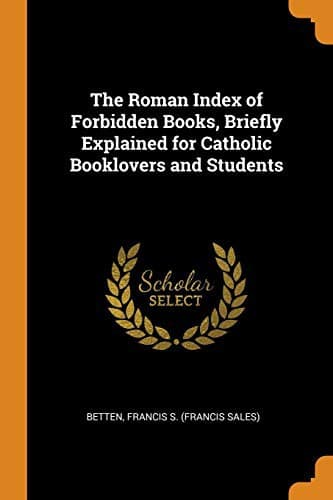
The Roman Index of Forbidden Books: Briefly Explained for Catholic Booklovers and StudentsBetten, Francis S. (Francis Sales)
Religion
The Roman Index of Forbidden Books: Briefly Explained for Catholic Booklovers and Students
Betten, Francis S. (Francis Sales)
Index librorum prohibitorum; Prohibited books
_Note 3._ In all other cases, each and every Catholic, be he priest or
layman, professor or student, must first obtain permission. Neither
piety, nor learning, nor position exempts one from this law. The
permission is granted by bishops and their vicars general, who can
also delegate this power to others. When asking for this permission
the applicant should mention the book which he thinks he has good
reasons to read.
The juridical question, whether the bishop’s faculty is _ordinaria_,
or _quasi-ordinaria_, or _extra-ordinaria_, and how far it extends, is
not within the scope of this Summary.
_Note 4._ All who are dispensed from the Church law regarding
forbidden books, must apply every possible precaution, in order that
they may not suffer injury to their faith or purity of heart. Such
precautions are: the hearing of sermons, the reading of Catholic
books, the frequenting of Catholic society, regular prayers, and the
frequent and humble reception of the sacraments.
2. Forbidden Books.
RULE 4. General Rule.—Translations of a forbidden book into any
language, if they faithfully reproduce the original, are also
forbidden.
A. The General Decrees Prohibit the Following Publications.
RULE 5, a. Books defending heresies, i. e. doctrines contrary to
divine revelation.
b. Books derogatory to God, the Blessed Virgin, the Saints.
c. Books vilifying the sacraments, the clerical or religious
state, the hierarchy, the Church.
RULE 6. Books professedly treating of, narrating or teaching lewdness
and obscenity.
RULE 7. Books teaching or recommending sorcery, Spiritism, Christian
Science, or other superstitions.
RULE 8. Books defending as lawful or harmless Freemasonry, divorce,
Socialism, suicide, duelling.
RULE 9. _Those newspapers and periodicals_ which, not only now and
then, but regularly and of set purpose, attack religion or morality,
or propagate anti-Catholic views.
RULE 10. Episcopal approbation, to be printed in the beginning or at
the end of the book, is required for all editions of the Bible or
parts of the Bible in any language, likewise for all prayer books,
books of devotion and of practical piety. Without episcopal
authorization such publications are forbidden, though they may have
been issued by the most learned and pious men.
_Note 1._ Leaflets which are so small that they cannot be called
books, or even booklets or pamphlets, do not fall under this law. But
if they are not approved by the bishop, the duty of making sure that
they contain nothing erroneous devolves upon those who use them.
_Summaries of indulgences_, however, no matter how small, always need
episcopal approbation and may not be circulated without it.
Public-domain text, read in full here on John Shaqi.
Reviews
Reviews
No reviews yet
Be the first to share your thoughts on this work.
Join the Discussion
Join the discussion
Sign in to leave a comment or review.
Sign InorCreate an account