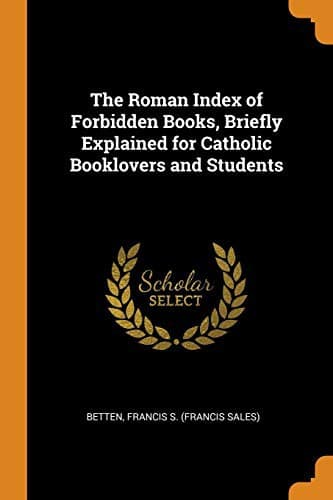
The Roman Index of Forbidden Books: Briefly Explained for Catholic Booklovers and StudentsBetten, Francis S. (Francis Sales)
Religion
The Roman Index of Forbidden Books: Briefly Explained for Catholic Booklovers and Students
Betten, Francis S. (Francis Sales)
Index librorum prohibitorum; Prohibited books
The fact that general councils as well as many popes have issued laws
and decrees regarding books, is sufficient evidence of their power and
of their commission to do this. This very fact must also convince us
that the observation of these laws must be salutary and conducive to
the welfare of the Church at large and of the individual Christian.
The inventions, discoveries and progress of our times can introduce no
change in this respect. The human mind is still as prone to err and as
much subject to the persuasive influence of books as it ever was.
Good books are as useful to-day as they were in olden times, and
objectionable writings have the same deplorable effects they had a
thousand years ago.
Nor can the Church, possessing the power to watch over our reading,
neglect to make use of this power when the salvation of souls calls
for its exercise. Bad literature is one of the worst enemies of
mankind. The Church can never allow it to corrupt the hearts of her
children or to undermine the foundation of their faith, without at
least raising a warning voice.
How great are the precautions the civil authorities take in case of an
epidemic; yet, no matter how seriously the precautions hamper traffic
and trade, we find them reasonable. We should even censure our
executive and legislative officers if they omitted to take proper
precautions. But, says Pope Leo, in the Constitution Officiorum ac
munerum, nothing can be conceived more pernicious, more apt to defile
souls than uncurbed license in the writing and disseminating of bad
books. “Therefore,” he continues, “the Church, whose office it is to
watch over the integrity of faith and morals, has ever striven, as far
as in her power lay, to restrain the faithful from the reading of bad
books as from a deadly poison.”
3. Book Prohibitions Antedating the Roman Index.
“The early days of the Church witnessed the earnest zeal of St. Paul,”
when the Christians at Ephesus brought together all the superstitious
books they had in their possession and burned them publicly. This
example of loyalty to the Church cost them, as Holy Scripture says,
between eight and nine thousand dollars. Such was the policy in regard
to bad books at Ephesus at a time when the Apostle whom many love to
call the most liberal and broadminded, ruled that part of the Church.
Every subsequent age records similar measures of vigilance. The first
General Council of Nicæa, in 325, besides proscribing the heresy of
Arius, also issued a decree prohibiting the use of Arius’ book
_Thalia_, which contained his heresy; indeed, at all times the
condemnation of a heresy by the Church entailed the prohibition of
the works propagating it. Pope St. Leo the Great, 440–461, does not
hesitate to declare that one who reads forbidden books cannot be
considered a Catholic.
Public-domain text, read in full here on John Shaqi.
Reviews
Reviews
No reviews yet
Be the first to share your thoughts on this work.
Join the Discussion
Join the discussion
Sign in to leave a comment or review.
Sign InorCreate an account