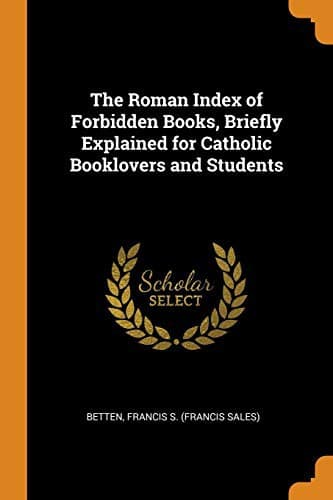
The Roman Index of Forbidden Books: Briefly Explained for Catholic Booklovers and StudentsBetten, Francis S. (Francis Sales)
Religion
The Roman Index of Forbidden Books: Briefly Explained for Catholic Booklovers and Students
Betten, Francis S. (Francis Sales)
Index librorum prohibitorum; Prohibited books
What has thus far been said, offers a partial solution of another
current error. The Index is not a studiously selected, not even a
systematically arranged catalogue of objectionable books. It was the
need of the moment, doctrinal blunders, cavillations and heresies,
grievous trespasses against discipline and charity, proceeding from
animosity or want of tact, that caused the insertion of most of the
books. In nearly all cases the Roman authorities confine themselves to
books concerning which they are appealed to; and as there is no system
in the making of these appeals, there can be no system in the
condemnations. In the new Leonine edition of the Index the books are
enumerated alphabetically by authors or pseudonyms; anonymous books
are listed according to titles.
It must now be obvious to the attentive reader why most of the books
put on the Index are works on theology, or on the history and
government of the Church, and why (as may be expected in the case of
such publications), a considerable percentage are written in Latin.
However, a goodly number of books are on the Index because they are
detrimental to good morals. There are very few there which treat of
the natural sciences. The Index will not busy itself with publications
on electricity or X-rays, unless an author on a subject of this sort
devote a considerable part of his work to attacks upon religion.
There are some well-meaning people who, while agreeing that the
productions of Zola, Dumas and other writers of the same sort, fully
deserve condemnation, cannot understand why works like Ranke’s
_History of the Popes_, which is an acknowledged authority in its
line, should be proscribed. Such works are not on the Index for the
good things they contain, but for the poison they mix with the
wholesome food so cleverly that it takes more than ordinary
scholarship and discretion to separate the one from the other.
The Roman Committee of Cardinals, which has charge of this part of
ecclesiastical discipline, is not at all bent on proscribing books.
Works like the one mentioned are never put on the Index unless it is
quite clear that the mischief to be feared from them will far outweigh
the good they may do. Scholars and students well grounded in their
faith, who have a real and legitimate cause for reading a forbidden
book can easily obtain a dispensation.
It is clear from the preceding explanations that a book may sometimes
be dropped from the Index. This is done when a book has long ceased
to be dangerous, or a cause of dissension, or if it has fallen into
oblivion. Thus Pope Leo XIII caused to be expunged about a thousand
titles. This does not imply a reproach for the authorities of former
centuries, much less the giving up of an iota of the old principles.
6. Duties Imposed by Law and by Nature.
Public-domain text, read in full here on John Shaqi.
Reviews
Reviews
No reviews yet
Be the first to share your thoughts on this work.
Join the Discussion
Join the discussion
Sign in to leave a comment or review.
Sign InorCreate an account