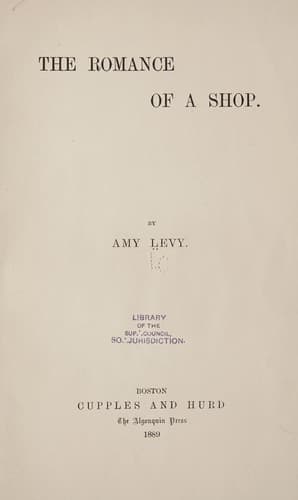
London (England) -- Fiction; Middle class women -- Fiction; Women -- Employment -- Fiction
Going up to the carved fire-place, Gertrude proceeded to warm her hands
at the comfortable wood-fire, a position badly adapted for taking stock
of the great man's possessions, of which, as she afterwards confessed,
she only carried away a prevailing impression of tiger-skins and
Venetian lanterns.
The fire-light played about her slim figure and about the faded richness
of a big screen of old Spanish leather, which fenced in the little bit
of territory in the immediate neighbourhood of the fire-place; a spot in
which had been gathered the most luxurious lounges and the choicest
ornaments of the whole collection; and where, at the present moment, the
air was heavy with the scent of tuberose, several sprays of which stood
on a small table in a costly jar of Venetian glass.
In a few minutes the sound of footsteps outside, and of the rich, deep
notes of a man's voice were audible.
"Et non, non, non,
Vous n'etes plus Lisette,
Ne portez plus ce nom."
As the footsteps drew nearer the words of the song could be clearly
distinguished.
Gertrude turned towards the door, which fronted the fire-place, and as
she did so the song ceased, the curtain was pushed aside, and a person,
presumably the singer, came into the room.
He was a man of middle height, and middle age, with light brown hair,
parted in the centre, and a moustache and Vandyke beard of the same
colour. He was not, strictly speaking, handsome, but he wore that air of
distinction which power and the assurance of power alone can confer. His
whole appearance was a masterly combination of the correct and the
picturesque.
He advanced deliberately towards Gertrude.
"Allow me, Miss Lorimer, to introduce myself."
He spoke carelessly, yet with a note of disappointment in his voice, and
a shade of moodiness in his heavy-lidded eyes.
Gertrude, looking up and meeting the cold, grey glance, became suddenly
conscious that her hat was shabby, that her boots were patched and
clumsy, that the wind had blown the wisps of hair about her face. What
was there in this man's gaze that made her, all at once, feel old and
awkward, ridiculous and dowdy; that made her long to snatch up her heavy
camera and flee from his presence, never to return?
What, indeed? Gertrude, we know, had a vivid imagination, and that
perhaps was responsible for the sense of oppression, defiance, and
self-distrust with which she followed Mr. Darrell across the room to one
of the easels, on which was displayed a remarkable study in oils of a
winter aspect of the Grand Canal at Venice.
There was certainly, superficially speaking, no ground for her feeling
in the artist's conduct. With his own hands he set up and fixed the
heavy camera on the tripod stand, questioned her, in his low, listless
tones, as to her convenience, and observed, by way of polite
conversation, that he had had the pleasure of meeting her sister the
week before at the Oakleys.
Public-domain text, read in full here on John Shaqi.
Reviews
Reviews
No reviews yet
Be the first to share your thoughts on this work.
Join the Discussion
Join the discussion
Sign in to leave a comment or review.
Sign InorCreate an account