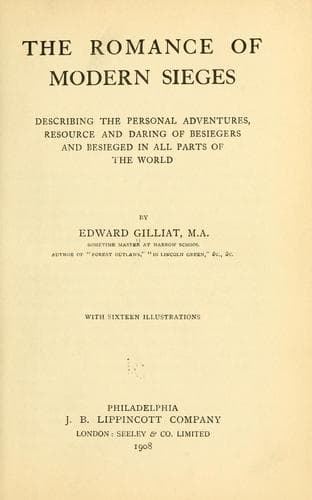
The Romance of Modern Sieges: Describing the personal adventures, resource and daring of besiegers and beseiged in all parts of the worldGilliat, Edward
History
The Romance of Modern Sieges: Describing the personal adventures, resource and daring of besiegers and beseiged in all parts of the world
Gilliat, Edward
Adventure and adventurers; Battles; Sieges; War
The next day many of these fugitives were marched along the boulevards,
their hands tied behind their backs, and the word _Lâche_ (coward)
printed in large letters between their shoulders. Yet still crowds
of men in uniform and ladies fashionably dressed crowded the cafés,
laughing and full of mirth.
As the bombardment grew, it became the fashion to gather at the
Trocadero, and watch the Prussian shells exploding in mid-air.
The village folk who had lived within the lines of investment were
brought inside the ramparts, and formed a class of _bouches inutiles_,
though some of the men were employed to cut down trees and build
barricades.
The Palace of St. Cloud was burnt down about this time--some said by
the French themselves, either by accident or design.
A post by balloon and by carrier-pigeons had been introduced--_par
ballon monté_--by which letters were sent away, but could not be
received.
[Illustration: THE BALLOON POST USED DURING THE SIEGE OF PARIS
Letters could be sent away by this method, but not received.]
In the middle of October Colonel Lloyd Lindsay arrived from England,
bringing with him £20,000 as a gift from England to the sick and
wounded. He came into Paris in the uniform of his rank. This did not
prevent his being captured as a spy, and suffering some indignities at
the hands of the great unwashed of Belleville. Some with questionable
taste said, “The English send us money--all right!--but why do they not
help us with men and guns?”
Trochu, the Governor of Paris, was thought to be rather infirm of
purpose; his sympathies were given more to Napoleon than to the
Republic, and he evidently distrusted the fighting men within Paris.
Indeed, there were many officers quite unfit for work, who used to
lounge about the cafés, their hands buried in a warm muff and their
noses red with the little glasses they had emptied. Many battalions
of Federals elected their own officers, and some men were seen to
be soliciting votes, bottle in hand. The National Guard, which was
somewhat like our militia, was distinct from the French army, and
contained many bad characters; they were apt to desert in time of
danger.
On the 21st of October there was a sortie against the Prussians on
the west of Paris. They started at noon, as Mont Valérien fired
three guns in quick succession. They took with them some new guns,
called mitrailleuses, from which great things were expected. In the
evening there came back a long procession of sixty-four carriages, all
filled with wounded. Crowds of anxious mothers came clustering round,
inquiring for friends. The people in the street formed two lines for
the carriages to pass between; the men respectfully uncovered their
heads.
Public-domain text, read in full here on John Shaqi.
Reviews
Reviews
No reviews yet
Be the first to share your thoughts on this work.
Elsewhere in the archive
Join the Discussion
Join the discussion
Sign in to leave a comment or review.
Sign InorCreate an account