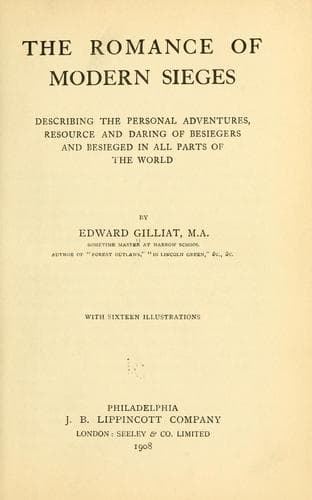
The Romance of Modern Sieges: Describing the personal adventures, resource and daring of besiegers and beseiged in all parts of the worldGilliat, Edward
History
The Romance of Modern Sieges: Describing the personal adventures, resource and daring of besiegers and beseiged in all parts of the world
Gilliat, Edward
Adventure and adventurers; Battles; Sieges; War
November came, with snow and bitter frost. Strange skins of animals
began to be worn; fuel was scarce, gas was forbidden, and epidemics
arose. The very poor received free meals from the _mairies_, while the
more respectable poor stayed at home, making no sign, but starving in
dumb agony.
On the 30th of November another sortie was attempted. Some villages
were taken by the French, Champigny and Brie, the mitrailleuses being
found very useful in sweeping the streets; but towards evening the
French were repulsed, and the commander of the 4th Zouaves was left by
his own men on the ground wounded, a shell having dropped near them.
Fortunately, the English ambulance was close by, and rendered such help
as was possible. Then they drove the helpless officer in a private
brougham back to Paris. What was their indignation when they found
great crowds of people of both sexes indulging in noisy games, as if it
was a holiday! The poor Chef de Bataillon only lived a few hours after
being taken to the hospital.
Next day ambulances were sent out to search for the wounded, but
they came upon many stragglers bent on loot. The wounded were in
sore plight after spending a night on the frozen ground. Some had
been able to make a little fire out of bits of broken wheels, and to
roast horse-flesh cut from horses which the shells had killed. The
French troops had remained in bivouac all that night, their strength
impaired by fatigue and cold; the German troops, on the contrary,
were withdrawn from the field of battle, their places being taken by
others who had not seen the carnage of the previous day, who were well
fed and sheltered, and thus far better fitted to renew the fight. No
wonder that the poor benumbed French failed to make a stout resistance.
Hundreds of wounded returned to Paris all the following day, and it
became evident that no effort to break the circle of besiegers could
succeed. Paris awoke at last to the humiliating truth. The day was
cold and foggy; the transport of wounded was the only sound heard in
the streets; in the evening the streets were dimly lit by oil-lamps,
shops all closed at sundown, and the boom of heavy guns seemed to ring
the knell of doom. All hope was now fixed on the provinces, but a
pigeon-post came in, telling them of a defeat near Orleans.
“The Army of the Loire has been cut in two! Tant mieux! (So much the
better!) Now we have two Armies of the Loire.” So the dandy of the
pavement dismissed the disaster with an epigram.
Public-domain text, read in full here on John Shaqi.
Reviews
Reviews
No reviews yet
Be the first to share your thoughts on this work.
Elsewhere in the archive
Join the Discussion
Join the discussion
Sign in to leave a comment or review.
Sign InorCreate an account