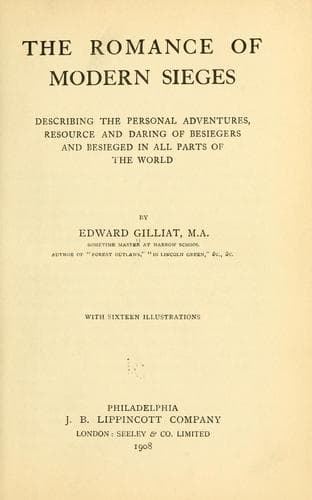
The Romance of Modern Sieges: Describing the personal adventures, resource and daring of besiegers and beseiged in all parts of the worldGilliat, Edward
History
The Romance of Modern Sieges: Describing the personal adventures, resource and daring of besiegers and beseiged in all parts of the world
Gilliat, Edward
Adventure and adventurers; Battles; Sieges; War
The scarcity of meat was felt in various ways; even the rich found
it difficult to smuggle a joint into their houses, for it was liable
to arrest on its way: some patriots would take it from a cart or the
shoulder of the butcher’s boy, saying, “Ciel! this aristocrat is going
to have more than his share.” One day a fashionable lady was returning
home carrying a parasol and a neat parcel under her shawl. After her
came six hungry dogs, who could not be persuaded to go home, though she
hissed and scolded and poked them with her gay parasol. On meeting a
friend, she first asked him to drive them away, and then confided to
him that she had two pounds of mutton in her parcel. And so the poor
dogs got none!
Amongst the hungry folk we must not forget that there were nearly
4,000 English in Paris, about 800 of whom were destitute, and would
have starved had it not been for the kindness of Dr. Herbert and
Mr. Wallace. The wounded were well looked after, for there were
243 ambulances, of which the largest, the International, had its
headquarters at the Grand Hotel. In one of the Paris journals it was
stated that a lady went to the Mayor’s house of her district to ask to
be given a wounded soldier, that she might nurse him back to life. They
offered her a Zouave, small and swarthy.
“No, no,” she exclaimed; “I wish for a blonde patient, being a brunette
myself.”
It was hardly worth while going to pay a visit to the Zoological
Gardens, for most of the animals had been eaten.
Castor and Pollux were amongst the last to render up their bodies
for this service. Castor and Pollux were two very popular elephants,
on whose backs half the boys and girls in Paris had taken afternoon
excursions. Poor fellows! they were pronounced later on by the critical
to be tough and oily--to such lengths can human ingratitude go when
mutton is abundant.
They were twins and inseparables in life. Their trunks were sold for 45
francs a pound, the residue for about 10 francs a pound. Besides the
loss of the animals, all the glass of the conservatories in the Jardin
des Plantes was shattered by the concussion of the big guns, and many
valuable tropical plants were dying.
The citizens, usually so gay and hopeful, presented a woebegone
appearance whenever they saw their soldiers return from unsuccessful
sorties. They began to look about for traitors. “Nous sommes trahis!”
was their cry. There was one private of the 119th Battalion who refused
to advance with the others. His Captain remonstrated with him; the
private shot his Captain rather than face the Germans. A General who
was near ordered the private to be shot at once. A file was drawn
up, and fired on him; he fell, and was left for dead. Presently an
ambulance stretcher came by, and picked him up, as a wounded man; he
was still alive, and had to be dealt with further by other of his
comrades. Let us hope that this man’s relations never learnt how
Jacques came to be so riddled by bullets.
Public-domain text, read in full here on John Shaqi.
Reviews
Reviews
No reviews yet
Be the first to share your thoughts on this work.
Elsewhere in the archive
Join the Discussion
Join the discussion
Sign in to leave a comment or review.
Sign InorCreate an account