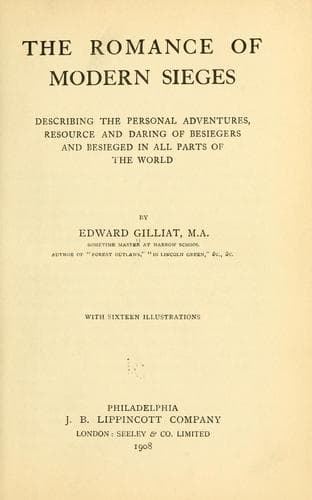
The Romance of Modern Sieges: Describing the personal adventures, resource and daring of besiegers and beseiged in all parts of the worldGilliat, Edward
History
The Romance of Modern Sieges: Describing the personal adventures, resource and daring of besiegers and beseiged in all parts of the world
Gilliat, Edward
Adventure and adventurers; Battles; Sieges; War
Kimberley could not at first believe war to be possible between the
Dutch and English, though they saw the regular troops putting up
earthworks and loopholed forts all round the town. Next a Town Guard
was formed to man the forts, while the 600 regulars and artillery were
to be camped in a central position ready for emergencies. Cecil Rhodes
arrived the last day the railway was open, and began at once to raise
a regiment at his own expense--the Kimberley Light Horse. All the
streets were blocked with barricades and barbed wires to prevent the
Boers rushing in. The main streets had a narrow opening left in the
centre guarded by volunteers, who had orders to let none pass without
a signed permit. Rhodes used to ride far out on the veldt, dressed in
white flannel trousers, though the Boers hated him, and would dearly
have liked to pot him at a safe distance.
Colonel Kekewich was in command--a man of Devon, and very popular with
his men. On the 24th of October they had their first taste of fighting,
when a patrol came across a force of Boers who were out with the object
of raiding the De Beers’ cattle. Kekewich, from his conning-tower,
could see his men in difficulties, and sent out the armoured train,
and the Boers were speedily dispersed. There were many wounded on both
sides, and the Mauser bullet was found to be able to drill a neat hole
through bone and muscle, in some cases without doing so much damage as
the old bullets of lower velocity in earlier wars.
At the beginning of the siege it was feared that water might fail, but
in three weeks the De Beers Company had contrived to supply the town
with water from an underground stream in one of their mines.
The bombardment began on the 7th of November, and, as at Mafeking, did
not do much damage, for the shells, being fired from Spytfontein, four
miles away, and being a “job lot” supplied to the Transvaal Government,
did not often reach the houses, and often forgot to burst. So that, it
is said, an Irish policeman, hearing a shell explode in the street near
him, remarked calmly to himself: “The blazes! and what will they be
playing at next?”
But by the 11th the Boers had brought their guns nearer, had found the
range, and were becoming a positive nuisance to quiet citizens.
Sunday was a day of rest and no shelling took place, but on other
days it began at daylight, and, with pauses for meals and a siesta,
continued till nine or ten o’clock at night. As usual, there were
extraordinary escapes. One shell just missed the dining-room of the
Queen’s Hotel, where a large company were at dinner, and, choosing the
pantry close beside it, killed two cats. Luckily there was time between
the sound of the gun and the arrival of the shell to get into cover.
The De Beers Company, having many clever engineers and artisans, soon
began to make their own shells, which had “With C. J. R.’s Compts.”
stamped upon them--rather a grim jest when they did arrive.
Public-domain text, read in full here on John Shaqi.
Reviews
Reviews
No reviews yet
Be the first to share your thoughts on this work.
Elsewhere in the archive
Join the Discussion
Join the discussion
Sign in to leave a comment or review.
Sign InorCreate an account