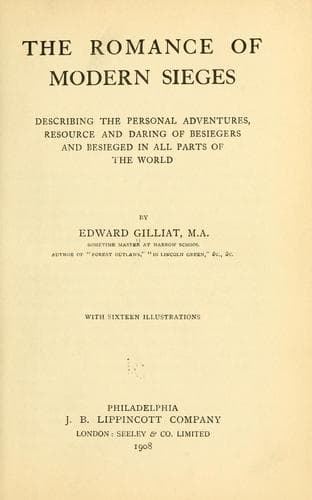
The Romance of Modern Sieges: Describing the personal adventures, resource and daring of besiegers and beseiged in all parts of the worldGilliat, Edward
History
The Romance of Modern Sieges: Describing the personal adventures, resource and daring of besiegers and beseiged in all parts of the world
Gilliat, Edward
Adventure and adventurers; Battles; Sieges; War
On the 28th November Colonel Scott Turner, who commanded the mounted
men, was killed in a sortie. He was a very brave, but rather reckless,
officer, and was shot dead close to the Boer fort.
Sometimes our own men would go out alone, spying and sniping, and in
many cases they were shot by their own comrades by mistake.
By December the milk-farms outside the town had been looted, and fresh
milk began to be very scarce; even tinned milk could not be bought
without a doctor’s order, countersigned by the military officer who was
in charge of the stores. The result was that many young children died.
At Christmas Sir Alfred Milner sent a message to Kimberley, wishing
them a _lucky_ Christmas. This gave the garrison matter for thought,
and the townsfolk wondered if England had forgotten their existence.
Those who could spent some time and care on their gardens, for they
tried to find a nice change from wurzels to beet, and even beans and
lettuce. For scurvy, the consequence of eating too much meat without
green stuff, had already threatened the town. Those who wanted food had
to go to the market hall and fetch it, showing a ticket which mentioned
how many persons were to be supplied. When horse-flesh first began to
be used by the officers, Colonel Peakman, presiding at mess, said
cheerfully: “Gentlemen, very sorry we can’t supply you all with beef
to-day. Beef this end, very nice joint of horse the other end. Please
try it.” But the officers all applied for beef, as the Colonel had
feared they would.
Then suddenly, when all had finished, he banged his hand on the table,
and said: “By Jove! I see I have made a mistake in the joints. This is
the capital joint of horse which I am carving! Dear! dear! I wanted
so to taste the horse, but--what! not so bad after all? Then you will
forgive me, I am sure, for being so stupid.”
All the same, some of them thought that the Colonel had made the
mistake on purpose, just to get them past the barrier of prejudice.
Towards the end of January the bombardment grew more severe; the shells
came from many quarters, and some were shrapnel, which caused many
wounds. The new gun made by the De Beers Company did its best to reply,
but it was only one against eight or nine. The Boers confessed that
they directed their fire to the centre of the town, where there were
mostly only women and children, for the men were away from home in the
forts or behind the earthworks. The townsfolk tried to improve their
shell-proof places, but most of them were deadly holes, hot and stuffy
beyond description, but that made by Mr. Rhodes around the Public
Gardens was far superior to the rest. The De Beers gun was named “Long
Cecil,” after Mr. Rhodes, and was about 10 feet long; it threw a shell
weighing 28 pounds. When it was first fired, the great question was,
“Will it burst?”
Public-domain text, read in full here on John Shaqi.
Reviews
Reviews
No reviews yet
Be the first to share your thoughts on this work.
Elsewhere in the archive
Join the Discussion
Join the discussion
Sign in to leave a comment or review.
Sign InorCreate an account