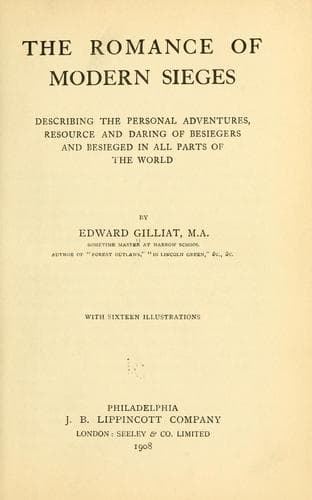
The Romance of Modern Sieges: Describing the personal adventures, resource and daring of besiegers and beseiged in all parts of the worldGilliat, Edward
History
The Romance of Modern Sieges: Describing the personal adventures, resource and daring of besiegers and beseiged in all parts of the world
Gilliat, Edward
Adventure and adventurers; Battles; Sieges; War
Major Rodger had sent some men to spy out the country, and was waiting
for their return. Presently he saw two men advancing towards him, and
thinking they were his own men he rode up to them. On drawing near
he saw they were Boers. His main body of men were far behind, and he
realized that if he galloped away he would be shot, so he quietly
walked his horse up to them. One of the Boers said: “Who are you?”
“Only one of the fighting-men from Kimberley,” the Major replied. They
did not draw their revolvers, they did not cry “Hands up!” and seize
him by the collar--no, all they did was to utter a brief swear, turn
their horses’ heads, and scamper over the veldt as fast as they could,
stooping over the pommel to avoid the Major’s fire. But half a mile
away they hit upon some of their own comrades, fired a few volleys,
broke the Major’s arm, and retired.
Major Rodger, however, had not done his day’s work, and never told his
men he had been shot until they returned to Kimberley in the evening.
So much for a Kimberley volunteer!
Meanwhile, the little folks and the women deep down in the mine--some
1,500 feet--were busy devouring sandwiches of corned-beef and horse,
and buckets of tea and coffee, with condensed milk, were lowered down
too. The large chamber cut out of the rock was lit with electric light,
and was not very hot, though it was crammed with children, many of
whom were lying on rugs or blankets; they lay so thick on the floor
that walking amongst them was the feat of an acrobat. But they were
safe down there! No ghastly sights of mangled limbs met their gaze, no
whizz of deadly shell, no scream of pain reached them there. It was
worth something to have escaped the horrors of a siege, and to feel no
nervous tremors, no cowardly panic, no dull despair.
Meanwhile Lord Roberts had not forgotten Kimberley. A force of some
5,000 sabres, led by General French, with two batteries of Horse
Artillery, had galloped in the dead of night to the Modder River. Here
a small Boer force fled from before them, and ever on through the
quivering heat rode Hussars, Dragoons, and Lancers, until both men and
horses fell out exhausted on the veldt. On the third day they came
close to some kopjes, or hills, on which Boers were posted, who stared
in amazement at the sight of the 9th Lancers sweeping in open order
round the base of the hills. A hundred miles they had ridden with scant
food and scanter water, so that the Boers might have been still more
surprised to see many a trooper walking by his tired steed, and even
carrying the saddle.
Dr. Conan Doyle tells us that “a skirmish was in progress on the 15th
of February between a party of the Kimberley Light Horse and some
Boers, when a new body of horsemen, unrecognized by either side,
appeared upon the plain, and opened fire upon the enemy. One of the
strangers rode up to the Kimberley patrol, and said:
“‘What the dickens does K.L.H. mean on your shoulder-strap?’
Public-domain text, read in full here on John Shaqi.
Reviews
Reviews
No reviews yet
Be the first to share your thoughts on this work.
Elsewhere in the archive
Join the Discussion
Join the discussion
Sign in to leave a comment or review.
Sign InorCreate an account