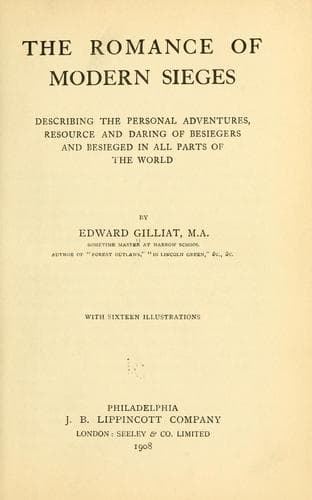
The Romance of Modern Sieges: Describing the personal adventures, resource and daring of besiegers and beseiged in all parts of the worldGilliat, Edward
History
The Romance of Modern Sieges: Describing the personal adventures, resource and daring of besiegers and beseiged in all parts of the world
Gilliat, Edward
Adventure and adventurers; Battles; Sieges; War
“‘It means Kimberley Light Horse. Who are you?’
“‘I am one of the New Zealanders.’”
How puzzled that member of the Kimberley force must have been--a New
Zealander out on the African veldt!
Soon the little clouds of dust on the horizon drew hundreds of
townsfolk to the earthworks, and as the glint of spear-head and
scabbard flashed out of the cloud, and the besieged garrison knew their
troubles were over, men waved their hats and shouted, and tearful,
laughing ladies flocked round the first men who rode in, and nearly
pulled them out of the saddle. Then they set to and hauled the rest out
of the mines, finishing that job well by midnight.
For 124 days Kimberley had been besieged. The Boers had never once
attacked the town, though not more than 550 mounted men were latterly
available for offensive work; these, with the Town Guard, Lancashires,
and Kimberley Rifles, made a total of 3,764. Colonel Kekewich might
well look radiantly happy; he had administered everything with strict
justice, and had earned the respect and admiration of all, while Cecil
Rhodes and the De Beers officials had magnificently met and countered
every difficulty with generous skill and unflagging energy.
CHAPTER XXV
THE SIEGE OF LADYSMITH (1899-1900)
Ladysmith--Humours of the shell--The _Lyre_ tries to be
funny--Attack on Long Tom--A brave bugler--Practical jokes--The
black postman--A big trek--Last shots--Some one comes--Saved at
last.
Ladysmith, where Sir George White and his men detained the Boers so
long, is a scattered town lying on a lake-like plain, and surrounded by
an amphitheatre of rocky hills. To the north-west was Pepworth Hill,
where the Boer Long Tom was placed; north-east of the town, and four
miles away, was Unbulwana: here the Boers had dragged a large siege-gun.
South of the town the Klip River runs close under the hills, and here
many caves were dug as hiding-places for the residents. There were many
women and children there all day long. On the 3rd of November the wires
were cut; Ladysmith was isolated and besieged. On the next day it was
discussed whether General Joubert’s proposal should be accepted--that
the civilians, women, and children should go out and form a camp five
miles off under the white flag. Archdeacon Barker got up, and said:
“Our women and children shall stay with the men under the Union Jack,
and those who would do them harm may come to them at their peril.”
The meeting cheered the tall, white-haired priest, and agreed thereto.
Public-domain text, read in full here on John Shaqi.
Reviews
Reviews
No reviews yet
Be the first to share your thoughts on this work.
Elsewhere in the archive
Join the Discussion
Join the discussion
Sign in to leave a comment or review.
Sign InorCreate an account