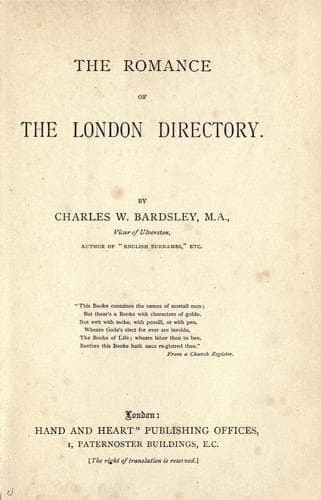
The Romance of the London DirectoryBardsley, Charles Wareing Endell
History
The Romance of the London Directory
Bardsley, Charles Wareing Endell
Names, English -- England -- London; Names, Personal -- England -- London
We are now well on the way to survey the groups or classes into which the
surnames in the London Directory can be divided. Nothing can simplify
the study of nomenclature so readily as a consideration of the classes
into which surnames may be placed. If the reader will turn to the
imaginary pedigree of the Colton family, he will see that the ten
surnames therein contained may be set under five heads. Richard of
Colton, William atte Pound, and James Bentham, are known by a
_place-name_; John Williamson, Adam Hawkins and Alice Adams by the
_father’s Christian name_; Richard the Baker by his daily _occupation_;
Bartholomew the Page by his _official capacity_; and Richard the Little
and Henry Whitehead by a sobriquet having reference to their _personal
appearance_. Here, then, are five distinct classes. There is not a
surname in the London Directory, nor in England, nor in Europe, nor in
the whole known or unknown world, that cannot be placed, and placed
correctly, under one of the five heads that I have thus foreshadowed:—(1)
Local names. (2) Baptismal names. (3) Names of occupation. (4)
Official names. (5) Nicknames. The first of these to become
_hereditary_ were the Norman local names. Many of the Conqueror’s
followers took or received as a surname the title of the place they left
in Normandy. He who left the chapelry of St. Clair across “the silver
streak” settled in England as “William, or Robert de St. Clair.” In
course of time this became “Sinclair” and “Sinkler;” just as “St. Denis”
became “Sidney;” “St. Pierre,” “Spier” and “Spiers;” or “St. Leger,”
“Selinger.” “Sinkler” is as vile a corruption of “Sinclair” as “Boil”
from “Boyle.” Some folk say, “What’s in a name?” One thing is clear:
there is a good deal in the spelling of it. These local names, however,
were the first hereditary names in England. But the Normans introduced
representatives of all five classes. Take a single instance of each.
Norman-English. Saxon-English.
I. Local Sidney Burton.
II. Baptismal Fitz-Hamon Jenkinson.
III. Occupative Taylor Baker.
IV. Official Chamberlain Steward.
V. Nicknames Fortescue Sheepshanks.
“Fortescue” means “brave” or “strong shield.” Hence the family motto has
a punning allusion: “_Forte Scutum_, salus ducum,”—_i.e._, “A strong
shield is the safety of leaders.” If we take a glimpse at any village
roll four hundred years ago, representatives of all these classes will
invariably be found, although the _baptismal_ and _local_ will largely
predominate. Look at the “Custom Roll and Rental of the Manor of
Ashton-under-Lyne, 1422” (Chetham Society Publications).
Public-domain text, read in full here on John Shaqi.
Reviews
Reviews
No reviews yet
Be the first to share your thoughts on this work.
Join the Discussion
Join the discussion
Sign in to leave a comment or review.
Sign InorCreate an account