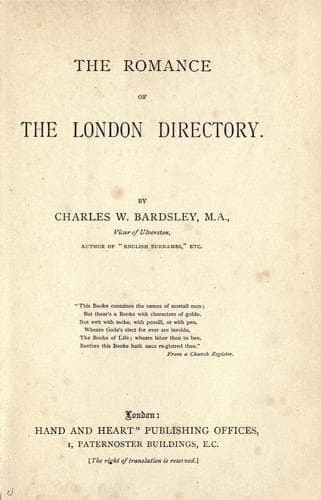
The Romance of the London DirectoryBardsley, Charles Wareing Endell
History
The Romance of the London Directory
Bardsley, Charles Wareing Endell
Names, English -- England -- London; Names, Personal -- England -- London
Five Hathaways and three Hathways still commemorate her in the Directory.
The termination “field” is corrupted into the form of “full” in several
cases; thus Charles Hatfull’s name reads somewhat queerly. Of course he
belongs to the Hatfields who figure just above him.
See the tendency to migrate _into_, and not _from_ London. The name
London is rare, as the Directory shows. A man leaving Buxton for the
capital, would be Walter-o’-Buxton; quitting the capital for the Peak of
Derbyshire, he would be Walter-o’-London. But the tendency being for a
young aspirant after fame and wealth to go _thither_, and not _thence_,
made the surname London of rare occurrence. Perhaps there has been more
than one Whittington who has fancied the bells have bid him stay and try
his luck again in that big centre of life and industry, whose title is
the most familiar place-name in the world. Curious that the mightiest
city of the mightiest empire should be so scantily represented in its own
Directory. The cause, as I have shown, is simple of explanation. We may
here set “New,” “Newman,” and “Strange.” A new comer would easily get
the sobriquet of “Matthew the New-man,” or “William the Strange,” or
“Henry the New,” in the fresh community to which he had joined himself.
The sobriquet has stuck to his children, and still remains.
(_e_) _Names of foreign towns_, the result of earlier or later
immigration, come next: such as “Cullen” from Cologne, a name very
familiar to English Roman Catholics; “Lyons” from the city devoted to the
silk trade; “Bullen” or “Boleyn” from Boulogne; or “Janeway” or
“Jannaway” from Genoa.
Many of these foreign town-names came into England through the fact that
the towns they represented were celebrated for some particular
production. The “Challens” of our Directory all hail from Chalons, once
so famous for its blankets that they were called “chalons” for several
centuries. The name still lingers in the woollen trade of Yorkshire as
“shaloon cloth.” Chaucer speaks both of “chalons” and “cloth of raines.”
This was made at Rennes in Brittany, and has furnished the London
Directory with its various Rains, Rain, Raine, and Raines. A writer in
the “Book of Days” says the following was written upon a lady bearing the
name of Rain:—
“Whilst shiv’ring beaux at weather rail,
Of frost, and snow, and wind, and hail,
And heat, and cold, complain,
My steadier mind is always bent
On one sole object of content,—
I ever wish for Rain!
“Hymen, thy votary’s praise attend,
His anxious hope and suit befriend,
Let him not ask in vain:
His thirsty soul, his parched estate,
His glowing breast commiserate—
In pity give him Rain!”
Public-domain text, read in full here on John Shaqi.
Reviews
Reviews
No reviews yet
Be the first to share your thoughts on this work.
Join the Discussion
Join the discussion
Sign in to leave a comment or review.
Sign InorCreate an account