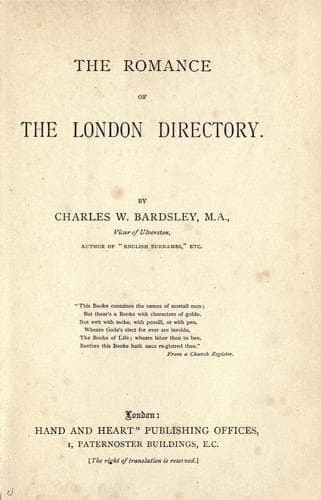
The Romance of the London DirectoryBardsley, Charles Wareing Endell
History
The Romance of the London Directory
Bardsley, Charles Wareing Endell
Names, English -- England -- London; Names, Personal -- England -- London
We can understand that at first it would seem strange for a _girl_ to go
by a patronymic of this kind. Imagine at this early stage of surname
formation some village maid bearing the name of Mary William_son_
(_i.e._, Mary, the son of William)! To us, accustomed to these names,
there seems nothing absurd in such a title as Matilda John_son_, or
Margaret David_son_. It never occurs to us to take the name to pieces,
and see the incongruity of its several elements. That this was a
difficulty to our forefathers is evident from the fact that there are
many entries like “Joan Willsdaughter,” or “Nan Tomsdaughter,” in the
registers of the thirteenth and fourteenth centuries. Thus “Isabella
Peersdoghter” lived near Durham four hundred years ago—_i.e._, Isabella,
the daughter of Peers, _i.e._ Peter. In the same way, “Avice
Mattwife”—_i.e._, Avice, the wife of Matt (Matthew)—or “Cecilia
Wilkin-wife,” is found at the same period. The reason why surnames
ending in _daughter_ are not found now, is that if the girl with such a
surname died unmarried, it died with her; if she married, she changed her
name. “_Son_,” as a termination having no difficulties of this kind to
contend with, has left us a multitude of names. Had it been otherwise,
we should have had surnames like Steven-daughter, Dick-daughter, and
Hopkin-daughter, contending for a place in our directories with
“Stevenson,” “Dickson,” and “Hopkinson.”
It would seem as if the female sex, therefore, had been hardly treated in
this matter of baptismal nomenclature. Indeed, some of my readers might
be tempted to ask me whether the gentler half of the community are
represented at all in our directories. I am happy to respond in the
affirmative. John and Margery might have a son, Robert by name. Now,
John is a timid, retiring kind of man; his wife being a bustling, active,
assertive woman. John sits in the chimney-corner, Margery does all the
marketing, all the talking, possibly all the working also. In a word,
she rules the roost. Naturally, the neighbours get into a way of calling
the child “Robert _Margeri_son,” rather than “Robert _John_son.”
Margerison, Margetson, and Margetts are all in the London Directory.
Take another instance: Hodge and Nell get married; Hodge dies, and a
posthumous child is born. Only the mother is living. As a matter of
course, the little one is styled Antony or Sarah _Nel_son, according to
its sex. A large number of metronymic surnames must be attributed to an
accident of this kind. All our “Ibbs,” “Ibbisons,” “Ibbsons,” “Ibbots,”
and “Ibbotsons” are sprung from Isabella, a much more common and familiar
name four or five hundred years ago than it is now. Our “Emmetts,”
“Emmotts,” “Emmotsons,” “Emms,” and “Empsons” are descendants of some
“Emma,” or “Emmot,” as she was then styled. Many people have refused to
believe that there are any metronymic surnames, for fear that it would
seem to imply illegitimate birth. It is always silly to deny facts, and
Public-domain text, read in full here on John Shaqi.
Reviews
Reviews
No reviews yet
Be the first to share your thoughts on this work.
Join the Discussion
Join the discussion
Sign in to leave a comment or review.
Sign InorCreate an account