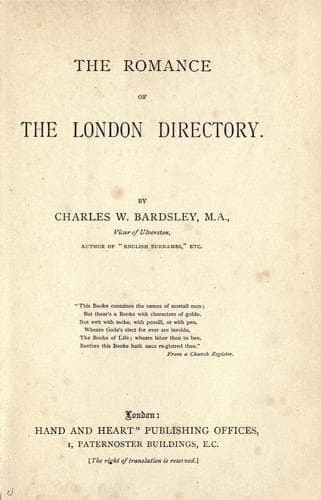
The Romance of the London DirectoryBardsley, Charles Wareing Endell
History
The Romance of the London Directory
Bardsley, Charles Wareing Endell
Names, English -- England -- London; Names, Personal -- England -- London
The first signs of serious change betrayed themselves at the beginning of
Elizabeth’s reign. The English Bible rested in English hands. But it
was a new book. Names familiar enough in 1877, but probably heard of for
the first time in 1577, were drawn forth from their concealment, and made
to subserve the new impulse of the nation. It was then that the minister
at the font had to begin registering such names as “Abacucke Harman,”
“Sydrach Sympson,” “Phenenna Salmon,” “Gamaliel Capell,” “Archelaus
Gifford,” “Melchizedek Payne,” “Dyna Bocher,” or “Zebulon Clerke.” It
was as if the Bible were a new country full of verdant tracks, and as
they passed through each plucked the flower that pleased him most. By
the time King James came to the throne, “Phineas,” “Philemon,” “Uriah,”
“Aquila,” “Priscilla,” and “Hilkiah” had become the rage. Before he
died, Harry had fallen into neglect, Ralph and Guy were utterly despised,
and names like Hamlet, or Hamnet (Shakespear’s son was Hamnet), or Avice,
or Douce, or Warin, or Drew, or Fulke, had gone down like sodden logs in
a stagnant pool. Whether they will ever come into use again is very
doubtful. Only national caprice can do it; but that, we know, can do
anything. That Avice, so pretty and simple as it is, should have
disappeared, I cannot but think a national loss.
By the time of Charles the First, the national taste had gone a degree
further. It becomes positively amusing to study the registers of this
period. It had evidently become a point of respectability among certain
classes of the community to select for their children the rarest names of
Scripture. John, Nicholas, Bartholomew, Thomas, and Peter, though
Scriptural, were tabooed; a stain rested on them, as having been in the
Calendar during centuries of popish superstition. In fact, the Apostles
were turned out for having kept bad company. Many seemed to have rested
their claim to thorough knowledge of the Bible upon the rarity of the
name they had discovered in its pages. Thus I find “Ebedmeleck
Gastrell,” whose Christian name only occurs once in the Scriptures (Jer.
xxxviii. 8). “Epaphroditus Houghton,” “Othniell Haggat,” “Apphia Scott,”
“Tryphena Gode,” “Bezaliel Peachie,” are cases in point. If a child were
styled by a new, quaint, unheard-of title, as a matter of course it was
assumed to be from the Bible. From the appearance of such a name as
“Michellaliell,” I fancy tricks of this kind were common.
Public-domain text, read in full here on John Shaqi.
Reviews
Reviews
No reviews yet
Be the first to share your thoughts on this work.
Join the Discussion
Join the discussion
Sign in to leave a comment or review.
Sign InorCreate an account