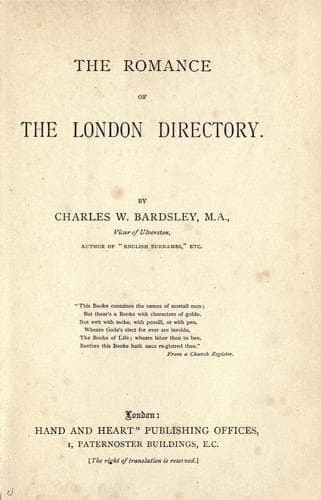
The Romance of the London DirectoryBardsley, Charles Wareing Endell
History
The Romance of the London Directory
Bardsley, Charles Wareing Endell
Names, English -- England -- London; Names, Personal -- England -- London
Another form, Catcherell, lingered on for a time in our nomenclature, but
it is now gone, unless Cattrall be but a corruption. An old sermon of
the fourteenth century speaks of the “devil and his angels” as the “devil
and his cachereles”! Our “Waites” and “Waits” represent the night
watchmen. As they both sounded the watches and gave the alarm with a
trumpet or horn, it came to pass that any band of night serenaders
acquired the name. We are all familiar with the Christmas “waits”! I
see there are two “Wakemans” in the Directory. The wakeman was the North
English form of “watchman,” just as kirk is North English for church, or
dike for ditch, or thack for thatch. Thus, Wycliffe translates Mark xii.
37, “Forsooth, that that I say to you, I say to all, Wake ye,” where our
modern translators have “Watch.” Strangely enough, in Psalm cxxvii. 1
they have employed both forms. “The watchman waketh but in vain,” should
have been either “The wakeman waketh but in vain,” or “The watchman
watcheth but in vain.” As it stands it is incongruous, for it gives the
modern reader the idea that the watchman had been asleep, implying that
he had been negligent, which, of course, is not in the original. When we
remember, as I have shown, that “wake” and “watch” were but the same word
with two pronunciations, one North English and the other South English,
the difficulty is explained. {107} A north countryman, if he wants to
say that his neighbour is a shrewd fellow, says, “Eh, but he’s a wak’
un.” I don’t know whether a Lancashireman or a Yorkshireman is the most
“wak’;” but an old saying gives the preference to the County Palatine.
If a Lancashireman wish to be ahead of a Yorkshireman, it says, he must
be up at two o’clock in the morning; but if a Yorkshireman wish to be
ahead of a Lancashireman, he mustn’t go to bed at all. We may surmise
that a Lancashireman originated the saying. Both “Wake” and “Sleep” are
in the London Directory. Brook, in his “History of the Puritans,”
relates a story concerning these two names. It seems, by a curious
coincidence, that Isaac Wake was University Orator at Oxford, in 1607,
Dr. Sleep being a well-known Cambridge preacher at the same time. James
the First, who not merely liked his joke, but was fond of listening to
sermons,—both characteristic of a Scotchman,—used to say, “he always felt
_inclined_ to Wake when he heard Sleep, and to Sleep when he heard
Wake”—_i.e._, he could not decide on the relative merits of the two.
Wake and Sleep will both be nicknames—the ancestor of the one doubtless
being a sharp shrewd fellow; the progenitor of the other, I daresay,
being thought somewhat dull and stupid by his neighbours.
Public-domain text, read in full here on John Shaqi.
Reviews
Reviews
No reviews yet
Be the first to share your thoughts on this work.
Elsewhere in the archive
Join the Discussion
Join the discussion
Sign in to leave a comment or review.
Sign InorCreate an account