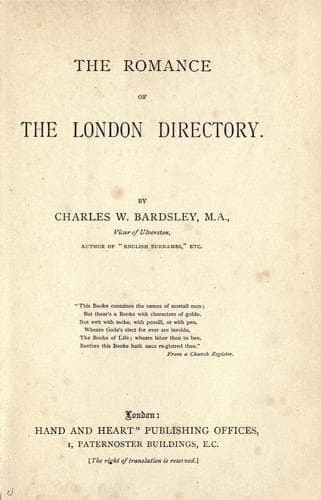
The Romance of the London DirectoryBardsley, Charles Wareing Endell
History
The Romance of the London Directory
Bardsley, Charles Wareing Endell
Names, English -- England -- London; Names, Personal -- England -- London
This short and piquant description is important because of the language
used. We still use the word flesh in the alliterative phrase, “fish,
flesh, and fowl;” but we should never ask for a “pound of flesh” in a
butcher’s shop now, any more than we should talk of the importation of
“American flesh.” We should say “meat.” The distinction, however, is
preserved in this account, and we are reminded that before the Norman
“Butcher” or “Boucher,” and French “_Labouchere_” came in, the seller of
flesh-meat was called a “Fleshmonger” or “Flesher.” So late as 1528,
William Fleshmonger, D.C.L., was Dean of Chichester. I fear the name is
now obsolete. Our “Fleshers” still exist, but most of them have become
absorbed in “Fletcher,” which represented the trade of feathering arrows:
we still employ the word “fledge.” The Bowyers and Fletchers and
Arrowsmiths always marched abreast in the old trades’ processions of
London, or York, or Norwich. Harking back to Fletcher, however, I may
add, that in Scotland a butcher is still a flesher.
So far for the butcher. But the old rhyme speaks of—
“The butcher, the baker,
The candlestick-maker.”
We next turn, therefore, to the bread and biscuit department. We have
all heard how that foolish and imprudent
“Miss Baxter,
Refused a man before he axed her,”
but few of us, possibly, are aware that “Baker” and “Baxter” and
“Bagster,” all represent the same occupation, and that Baxter is only the
old “bakester,” the feminine of Baker, just as Webster is the feminine of
Webber, or Brewster of Brewer, or Blaxter (_i.e._ “Bleachster”) of
Bleacher, or Tapster of Tapper. {122} Langland, in his poem entitled
“The Vision of Piers Plowman,” speaks of
“Baksteres and brewesteres,
And bochiers manye.”
It will not be irreverent to note the coincidence, that no firm in
England have more closely associated their name with the printing of the
Bible, “The Bread of Life,” than the Bagsters. It reminds us of that
which was no accidental coincidence at all—namely, that Christ Himself,
“that true Bread which came down from Heaven,” appeared first at
Bethlehem, which literally means “house of bread,” _i.e._ “bread-shop,”
or “bake-house.” “Bacchus,” as already noted, is a corruption of
“bake-house,” while our Bullingers, Ballingers, Bollengers, and Furners,
and “Pesters,” represent the Norman-French bakers. Our “Cokes” and
“Cooks” represent the old public pie-shop, as well as the private
cuisine, and this explains the large number of the fraternity
immortalised in our directories. An old poem speaks of
“Drovers, cokes, and poulters,
Yermongers, pybakers, and waferers.”
There has ever been a great race in this matter between our “Bakers” and
“Cooks” or “Cookes.” Nearly thirty years ago Mr. Lowe, in his Tables of
Births, Deaths, and Marriages, gave the following analysis for one year
in England and Wales:—
Public-domain text, read in full here on John Shaqi.
Reviews
Reviews
No reviews yet
Be the first to share your thoughts on this work.
Elsewhere in the archive
Join the Discussion
Join the discussion
Sign in to leave a comment or review.
Sign InorCreate an account