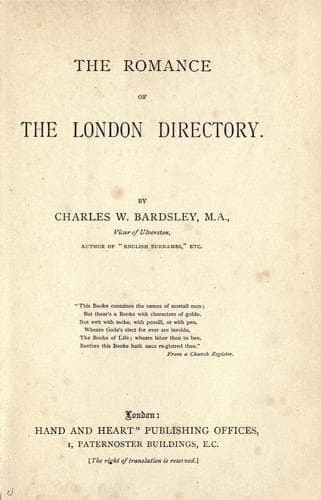
The Romance of the London DirectoryBardsley, Charles Wareing Endell
History
The Romance of the London Directory
Bardsley, Charles Wareing Endell
Names, English -- England -- London; Names, Personal -- England -- London
In the latter decades of last century there was a celebrated surgeon in
Manchester of the name of “Killer,” which is a corruption of “Kilner,”
just as Miller and Milner are identical. But if this was an unfortunate
name for a surgeon, what shall we say of “Kilmister” and “Kilmaster,”
which may be found in and about the county of Gloucester! How
bloodthirsty they look!—and yet the truer form Kilminster, in the London
Directory, strips them, by the addition of but one letter, of their
terrors, and shows them to be of local origin. In one of the earliest
metropolitan directories appears a Mr. Toothaker! It was not an uncommon
name, for in 1635 there embarked in the _Hopewell_ for New England, Roger
Toothaker and Margaret Toothaker! I do not think the name to be of
German origin, as Mr. Lower supposes, but one of those local English
surnames ending in “acre,” like Whittaker or Oldacre. The sobriquet,
however, reads oddly enough, and looks as if the services of the barber
were much required.
Turning to dress for a moment, we may notice that there are nearly 300
Walkers in the London Directory, almost 100 Tuckers, 80 Fullers, and 20
Tozers. All were concerned once with the combing, fulling, dyeing, and
thickening of woollen goods. In Piers Plowman mention is made of
“fulling under foot.” This refers to the practice of _treading_ the
cloth, before machinery was introduced. He who did this was a _walker_.
Wycliffe, speaking of Christ’s transfiguration, describes Christ’s dress
as shining, so as “no fullers or walkers of cloth” could whiten them.
The “tozer” or “toser,” or “touser,” toused or teased the fabric, so as
to raise a nap on it. We talk of _teasing_ now in the sense of worrying
people with attentions. This is the secondary meaning that has grown
upon the other. “Tozer” and “Toser” are the favourite spellings of this
occupation in the Directory. We are still fond of calling a pugnacious
dog “Towser.” _Tucker_ was a Flemish introduced term for a “dyer.” Many
of the words connected with the manufacture of cloth came in with the
Flemish artisans.
Public-domain text, read in full here on John Shaqi.
Reviews
Reviews
No reviews yet
Be the first to share your thoughts on this work.
Elsewhere in the archive
Join the Discussion
Join the discussion
Sign in to leave a comment or review.
Sign InorCreate an account