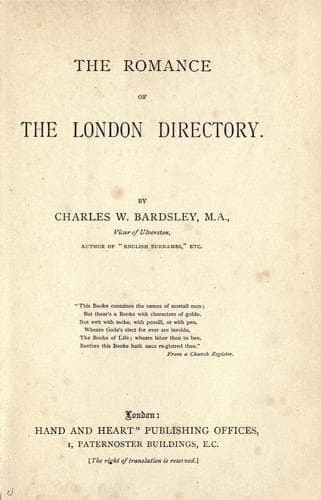
The Romance of the London DirectoryBardsley, Charles Wareing Endell
History
The Romance of the London Directory
Bardsley, Charles Wareing Endell
Names, English -- England -- London; Names, Personal -- England -- London
Again, in a spirit of devout meekness, he writes, “As for other stains
and spots upon my soul, I hope that He (be it spoken without the least
verbal reflection) who is the Fuller’s sope, will scour them forth with
His merit, that I may appear clean by God’s mercy.” It was but natural,
that when this great religious punster died, a suggestion should have
been made that his epitaph should run thus: “Here lies Fuller’s earth.”
{138} This was not done, and just as well it was not; for if puns are
ever objectionable, it is when they appear in epitaphs. Nevertheless,
one of the finest instances of paranomasia on record is to be found on
the tablet to Foote’s memory in Westminster Abbey:—
“Here lies one Foote, whose death may thousands save;
For now Death hath one Foote within the grave.”
A similar interchange of _nominal_ courtesies is observable in the names
of cattle and wild beasts. Pigg, Hogg, Stott, Colt, Bullock, Duncalf,
Wolf, Lamb, Kidd, Bacon, Grice, and Wildbore all speak for themselves;
while in our North English Oliphants and Olivants we recognize the old
spelling of “elephant.” No doubt the original bearer of the nickname was
of unusually large proportions even for the border country of England and
Scotland. Speaking of Lamb, we are reminded that a brother-in-law of
John Wesley bore the name of Whitelamb, and therefore could scarcely be
called, under any circumstances, a black sheep! There are six Bears and
eighty Bulls in the Directory. The _Gentleman’s Magazine_ for 1807
records the death of “Savage Bear, Esquire,” who was a resident in Kent.
In the same article mention is made of a Mr. Mould, cheesemonger, in
Newgate Street. But we have Bearmans, Bullards (that is, Bullwards),
Bulmans, and Bullpitts in our Directory, too. It was not till 1835
bear-baiting and bull-baiting were forbidden by Act of Parliament. It
had reigned at the head of English pastimes for six centuries. Hence it
was a common inn-sign. The oldest hostel in London was supposed to be
the “Bear,” on the Southwark side of old London Bridge. Hence an old
poem says,—
“We came to the Bear, which we soon understood
Was the first house in Southwark built after the flood.”
Public-domain text, read in full here on John Shaqi.
Reviews
Reviews
No reviews yet
Be the first to share your thoughts on this work.
Elsewhere in the archive
Join the Discussion
Join the discussion
Sign in to leave a comment or review.
Sign InorCreate an account