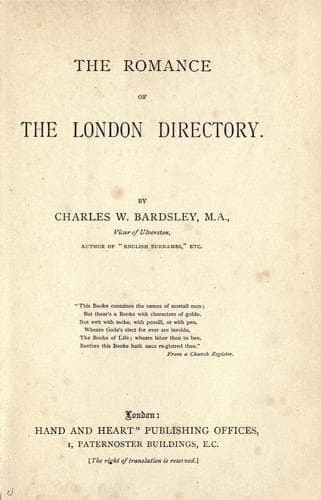
The Romance of the London DirectoryBardsley, Charles Wareing Endell
History
The Romance of the London Directory
Bardsley, Charles Wareing Endell
Names, English -- England -- London; Names, Personal -- England -- London
Every rich man had his bearward, and the royal houses had their “master
of the king’s bears.” Both Mary and Elizabeth enjoyed a good baiting,
whether of bulls or bears. The Puritans of course were against it, and
so far were in advance of the times, but it is a peculiar feature of
their opposition that they scarcely ever refer to the cruelty of the
sport. Orthodox and somewhat dull Pepys describes in 1666 how he saw
some good sports of the bulls tossing the dogs—one into the very boxes.
A leading Puritan minister not twenty years later is always found, by his
own published diary, to have sent his children to the cock-pit on
Shrove-Tuesday to witness the “throwing-at-the-cock,” and he piously
prays they may be preserved from harm while away (“Newcome’s Diary,”
Cheetham Society’s Publications). Thus it is we find so many “Cockers”
and “Cockmans” in the Directory. As for our “Cocks” or “Coxes,” every
young gallant who showed determined pluck, or strutted in his gait, or
gave himself airs, was nicknamed from the cockpit or barn-door
dictionary. No wonder our Directory teems with them, for it would be
looked upon in bygone days as a pretty compliment. This is the origin of
“cock” in such mediæval pet names as Wilcock, Jeffcock, Batcock and
Badcock (Bartholomew), Simcock, Hancock and Handcock (Hans, _i.e._
Johannes), Bawcock (Baldwin), Pidcock and Peacock (Peter), Philcock, now
Philcox, and Adcock or Atcock (Adam). To give my readers a list of the
views propounded as to the meaning of this desinence would take too much
space. Suffice it to say that nothing has seemed too absurd for those
who love “guesses at truth,” without ever guessing right, to advance.
Every rustic lusty lad was “Cock,” especially if he had a perky cocky way
of his own. And in these names of Philcock or Jeffcock, we simply see
the old-fashioned way of hailing Philip or Jeffery as, “Well, Jeff-cock,
lad, how art thou?” “Pretty well, Phil-cock, thank’ee.” In the old
play, _Gammer Gurton’s Needle_, Gammer’s servant lad is called simply
“Cock,” without the baptismal name being appended at all. It is so in
the mediæval poem entitled “Cocke Lorell’s Bote.”
Public-domain text, read in full here on John Shaqi.
Reviews
Reviews
No reviews yet
Be the first to share your thoughts on this work.
Elsewhere in the archive
Join the Discussion
Join the discussion
Sign in to leave a comment or review.
Sign InorCreate an account