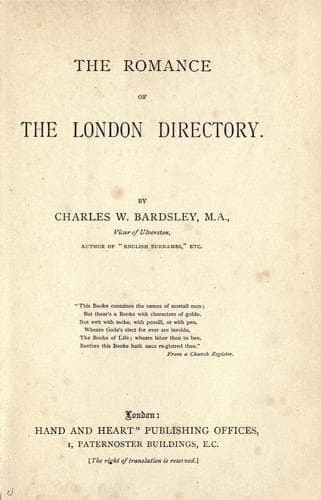
The Romance of the London DirectoryBardsley, Charles Wareing Endell
History
The Romance of the London Directory
Bardsley, Charles Wareing Endell
Names, English -- England -- London; Names, Personal -- England -- London
But we have got among the birds again. We must hark back to our
four-footed friends. There are no “Donkeys” in the London
Directory—probably the only place in the world where they are not to be
found. But this may be accounted for, perhaps, because there are no
Thistles there either. Nevertheless, had there been an English Directory
in the year when Domesday Book was compiled, it would have been
otherwise; for, thistles or no thistles, “Roger the Ass” is among the
list of tenants under the crown. Here we have been liberal: for we have
presented our good thistle-loving friend with no less than three of our
baptismal names. In the north of England, where Cuthbert was the
favourite appellation for three centuries at least, he is called a
_Cuddy_, that being the pet form of the saintly sobriquet. {141} In more
southern regions he is known as _Ned_ or _Neddy_, from Edward. And north
and south alike, _Jack_-ass is familiar to all. It is curious to notice
how a name that has become opprobrious can be dropped. “Rascal” was one
of our commonest surnames while the term only meant a lean, ragged deer;
but when it was passed on to a _herd_ of worthless folk the surname
disappeared. One of the latest was Robert Rascal, who, according to
Foxe, was persecuted for his religion in 1517.
I must not omit the mention of one or two of our household favourites.
There are five Catts in our London Directory, entered in old days as Adam
le Kat, or Milo le Chat. In the reign of Richard the Third, there was a
rhyme to this effect:—
“The Rat, the Cat, and Lovel the Dog,
Rule all England under the Hog.”
The Hog was the king, Rat was Ratcliffe, and Cat, Catesby. It is not
often we hear of cat, dog, and rat, uniting together to worry others, and
not one another! If I recal my history correctly, however, they did fall
out in the end.
There must have been something sleek and smooth, if not stealthy, about
the progenitor of our friends the Catts, I fear. But if our mouse-loving
friends gave us their appellation, we were bountiful in return. For
three hundred years the most familiar term for a cat was “Gib,” from
Gilbert. Hamlet says:—
“For who that’s but a queen, fair, sober, wise,
Would from a paddock, from a bat, a gib,
Such dear concernings hide?”
And in Peele’s “Edward the First,” the Novice says to the Friar:—
“Now, master, as I am true wag,
I will be neither late nor lag,
But go and come with gossip’s cheer
Ere Gib, our cat, can lick her ear.”
That Gib was short for Gilbert, our Gibbs, Gibsons, Gibbins, and Gibbons
can prove. But “Gib” for a cat is obsolete, I fear; and now we speak of
a Tom-cat. A female cat was called a Tib-cat, or Tibert, from Tibb, or
Tibot, pet forms of Theobalda, which at one period as Tibota was our
commonest girl’s name. In “Gammer Gurton’s Needle,” one of our very
earliest dramatic plays, Dicon (Richard) says:—
Public-domain text, read in full here on John Shaqi.
Reviews
Reviews
No reviews yet
Be the first to share your thoughts on this work.
Elsewhere in the archive
Join the Discussion
Join the discussion
Sign in to leave a comment or review.
Sign InorCreate an account