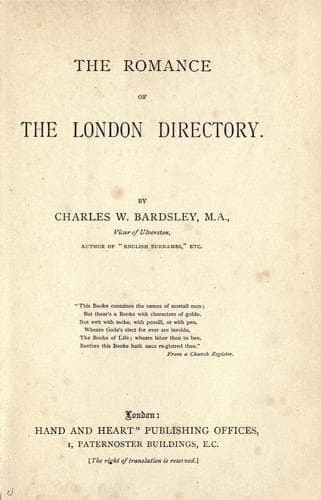
The Romance of the London DirectoryBardsley, Charles Wareing Endell
History
The Romance of the London Directory
Bardsley, Charles Wareing Endell
Names, English -- England -- London; Names, Personal -- England -- London
But these are not the only names we owe to the animal creation. Our
forefathers loved descriptive compounds. After all, there is nothing
very terrible in being nicknamed a “wolf,” or a “stott,” or a “peacock,”
or a “buzzard,” or a “salmon,” or a “fly.” Our national nickname is
“John Bull,” and who ever got into a state of virtuous indignation about
that? Yet “bull” is not, taken all round, a very complimentary
sobriquet. He’s a stubborn, bellicose, lumbersome kind of creature; and
it’s wonderful what a little matter, such as a red rag, will set him into
a fury! How frequently we term a man a pig-headed fellow. That was a
favourite kind of nickname in old days, and our registers are not without
traces of this. We have still Colfox, that is, sly fox. Herring is
common; but once we had Freshherring, Goodherring, Badherring, and
Rottenherring in our Directories. Pigg, Grice, and Hogg are still to the
fore; but Cleanhog, Cleangrice, and Pigsflesh are all gone. Hogsflesh,
as stated before, still exists in the South of England; and a rhyme says
that—
“Worthing is a pretty place,
And if I’m not mistaken,
If you can’t get any butchers’ meat,
There’s Hogsflesh and Bacon.”
Other compound nicknames of the same class are Poorfish, Catsnose,
Cocksbrain, Buckskin, Goosebeak, Bullhead, and Calvesmaw; but they have
all been shuffled out of our Directories, to give place to sobriquets
more pleasant of origin, and more euphonious in sound.
In my next chapter I shall proceed with this subject, and, if I can
retain my readers’ attention, we shall discuss Nicknames taken from moral
and mental and physical characteristics—not affixed through the agency of
typical animal names, but by the ordinary and more direct phraseology.
CHAPTER X.
NICKNAMES (_continued_).
OUR last chapter was devoted to the consideration of nicknames of a
particular class—viz., animal names. We said that, to all intents and
purposes, Sly and Fox were the same—one representing a term for cunning,
the other a type. But while re-asserting this statement, we are met by a
difficulty. Many generations have elapsed since such a nickname as Sly
was fixed upon its original bearer. Did the word “sly” then mean what it
now means? Was the name “Sly” given as a disparaging sobriquet, or a
compliment? Most probably the latter. Sly, or Sleigh, implied honest
dexterity long before the juggler with his sleight-of-hand tricks ruined
its verbal reputation. Even two hundred years ago only, when a
well-known poet spoke of a good man as one whom—
“Graver age had made wise and sly,”
he was not misunderstood.
Public-domain text, read in full here on John Shaqi.
Reviews
Reviews
No reviews yet
Be the first to share your thoughts on this work.
Elsewhere in the archive
Join the Discussion
Join the discussion
Sign in to leave a comment or review.
Sign InorCreate an account