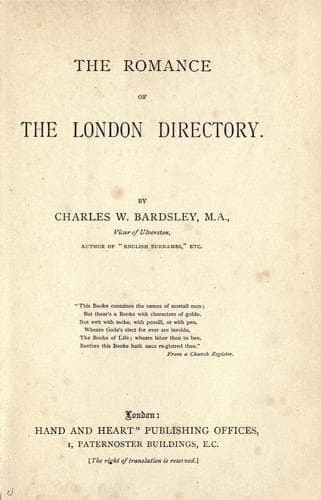
The Romance of the London DirectoryBardsley, Charles Wareing Endell
History
The Romance of the London Directory
Bardsley, Charles Wareing Endell
Names, English -- England -- London; Names, Personal -- England -- London
It is so with many other nicknames; and this explains the fact of their
existence. Had Sly or Sleigh or Slee been confined to its present
meaning three hundred years ago, we should not have found it in our
directories in 1878. Our Seeleys and Selymans, our Sillys and Sillymans
would probably have become nominally defunct, if silly had conveyed its
modern meaning to the ears of our forefathers. “Silly,” in former days,
implied _guilelessness_; we still use it in this sense in the phrase
“silly lamb.” An old proverb says:—
“Whylst grasse doth growe,
Oft starves the seely steede.”
The best instance, however, I know of this use of the word is in Foxe’s
Martyrology, where, describing the martyrdom of a young child not seven
years old, he says: “The captain, perceiving the child invincible, and
himself vanquished, committed the silly soul, the blessed babe, the child
uncherished, to the stinking prison.” Here, of course, _silly_ is the
equivalent of innocent, or inoffensive. Our Sillymans and Sillys and
Seeleys may fairly claim that theirs was a complimentary nickname. I
mention these as instances only of a large class.
When we come to _bonâ-fide_ cases, we shall discover, not with any
surprise, that almost all our nicknames are complimentary! Our
forefathers must have been a most highly respectable set of fellows,
judging by this famous Directory. They never got drunk, for who can find
a man who but rarely transgressed the limit of sobriety in our
directories? There is not a trace of meanness or cowardice about them.
’Tis true Coward is a common name, but then, as already shown, it is not
a nickname at all, but an occupation, being none other than our old
friend the cow-herd. On the other hand, see what a large number of
Doughtys there are, and Bolds, and Gallants, and Prews, all backed up by
Hardy, who worthily sits in the Cabinet. We meet with courtesy in our
Curtis’s and Curteis’s; with nobility in our Goodharts and Trumans; with
humility in our Humbles and Meeks; with kindliness in our Gentles and
Sweets; with firmness in our Steadys and Graves; and with liveliness in
our Sharps, Quicks, and Wittys. Nor are more abstract charms wanting.
It can be truly said that there are plenty of Graces, for at least twelve
appear. Faith and Hope are there,—only Charity is wanting. Honour,
Virtue, and Wisdom, however, make up in some degree for the absence of
that gentle quality. Some people are “Good,” but to be “Goodenough” and
“Thorowgood” or “Thoroughgood,” let alone “Toogood,” seems only possible
in our nomenclature. Many people, too, are “Perfect” in it, and “Sin” is
not there, though “Want” is. Some cynic may say that Truth is
conspicuous by its absence, but how can that be in the presence of five
“Veritys”? Not merely are we in the atmosphere of constant Spring, and
Blossoms, and Budds, but twenty-five Summers appear in the same year, and
Rosinbloom blows the twelve months round! The “Tabernacle,” the
Public-domain text, read in full here on John Shaqi.
Reviews
Reviews
No reviews yet
Be the first to share your thoughts on this work.
Elsewhere in the archive
Join the Discussion
Join the discussion
Sign in to leave a comment or review.
Sign InorCreate an account