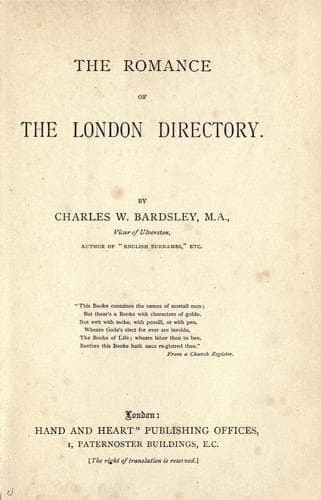
The Romance of the London DirectoryBardsley, Charles Wareing Endell
History
The Romance of the London Directory
Bardsley, Charles Wareing Endell
Names, English -- England -- London; Names, Personal -- England -- London
One of the earliest ways of forming a surname of the nickname class was
to compound with the baptismal name an adjective of size, age,
relationship, or condition. We are all familiar with such a name as
Little-john, which may well stand as a typical illustration, for I see in
my London Directory nine instances occur. The father of the original
bearer was doubtless John, and the son being baptized by the same
agnomen, the neighbours would readily get into the way of styling him
Little John. The grandson would accept this as his surname, and thus the
sobriquet would become a permanency. These compounds of John are not
uncommon, for that was the commonest baptismal name in those days, save
William. Thus we have Mickle-john, _i.e._ big John; Brown-john;
Hob-john, _i.e._ clownish John; and Young-john, an instance of which I
saw in Kidderminster not long ago. By means of French importation, or
through our Norman forefathers, we have also Pru-jean, Gros-jean, and
Petit-jean. Proper-john, though not in the London Directory, is very
common in some parts of the country, and implied that the original bearer
was a well-formed, shapely youth. This old use of the term is preserved
in our Authorized Version, where St. Paul is made to speak of Moses as “a
proper child.” Our Properjohns need not be ashamed of their designation.
Speaking of Youngjohn, I may state that in one of our Yorkshire local
directories may be seen _John Berry_, and immediately below _Young John
Berry_. Doubtless the son was baptized “Young John,” to distinguish him
from his father; and thus an old custom was but restored in a more formal
manner at the font. As Young John Berry has now grown to man’s estate,
as is proved by the fact that he occupies a place of his own in the
aforementioned directory, we may, perhaps, some day see in a future issue
of that same public register, “_Still Younger John Berry_” as the title
of the representative of the third generation! The most interesting name
in its associations, however, is that of Bon-jean or Bon-john, _i.e._
Good John, corrupted into Bunyan. So early as the year 1310 there dwelt
in London a householder of the name of Jon Bonjon. My readers will deem
it, I doubt not, a happy coincidence that when we speak of the author of
the immortal “Pilgrim’s Progress” as “Good John Bunyan,” we are simply
saying twice over “Good John”: once in English, and once in French.
Probably the ancestor of the dreamer of Bedford was a Norman tradesman,
who had come over to London to better himself.
Public-domain text, read in full here on John Shaqi.
Reviews
Reviews
No reviews yet
Be the first to share your thoughts on this work.
Elsewhere in the archive
Join the Discussion
Join the discussion
Sign in to leave a comment or review.
Sign InorCreate an account