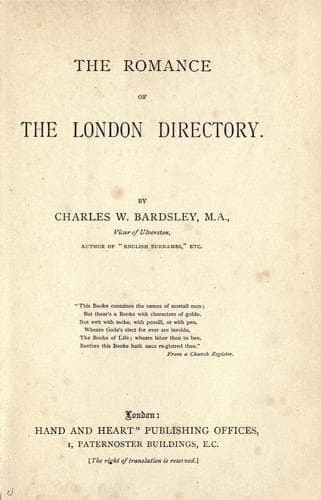
The Romance of the London DirectoryBardsley, Charles Wareing Endell
History
The Romance of the London Directory
Bardsley, Charles Wareing Endell
Names, English -- England -- London; Names, Personal -- England -- London
Speaking of these Norman-French names ending in Jean, such as Gros-Jean,
Petit-Jean, or Bon-Jean, we are reminded that this mode of forming
surnames was much more common in France than in England. A single glance
at the Paris Directory will amply demonstrate this. We find Grand-jean
(Big-John), Grand-perret and Grand-pierre (Big-Peter), Grand-collet
(Big-Nicholas), and Grand-Guillot (Big-William). Of an opposite
character we light upon Petit-collin (Little Nicholas), Petit-guillaume
(Little-William), Petit-perrin and Petit-pierre (Little-Peter), and
Petit-jeannin, corresponding to our English Little-john already alluded
to. These instances, which might be amplified to any extent, will
suffice to prove that nicknames of this class are far more prevalent with
our French neighbours than ourselves.
But while such qualificatory terms as “good,” “long,” “young,” and
“proper,” were freely applied to baptismal names, they were not limited
to such. Long-skinner used to exist as a surname, also Young-smith and
Good-groom. One of our most aristocratic names is Beau-clerk; and its
opposite, Mau-clerk, once familiar enough to our ears, still exists in
the corrupted form of Manclerk. Talking, however, of ears, the name that
sounds most curious upon the modern tympanum is that of Good-Knave. This
is no corruption, and meant exactly what it seems to mean—that the
original bearer was a good honest knave! But then, as many of my readers
are aware, there was a time when a knave was nothing more than a servant
or page. Shakespear speaks of one who is but
“Fortune’s knave,
A minister of her will.”
Young-husband, of which there are four representatives in our London
Directory, is a very familiar instance of this class, although _husband_
had no doubt a much wider significance in the day that the surname arose.
Goodfellow is also well known; and, above all, one of our American
cousins has made Longfellow famous to all time. If you come to analyse
the name of the author of “Evangeline,” it has not a very attractive
origin. The earliest instances I can find are in our Yorkshire records,
and there it is set down Long-fellay. Even now in Lancashire and
Yorkshire a fellow is always a “felley.” I wonder if Henry Longfellow
ever heard of Thomas Longfellow, landlord of the Golden Lion Inn at
Brecon, who must have made a somewhat _long_ face when he saw the
following lines inscribed upon a panel of his coffee-room:—
Public-domain text, read in full here on John Shaqi.
Reviews
Reviews
No reviews yet
Be the first to share your thoughts on this work.
Elsewhere in the archive
Join the Discussion
Join the discussion
Sign in to leave a comment or review.
Sign InorCreate an account