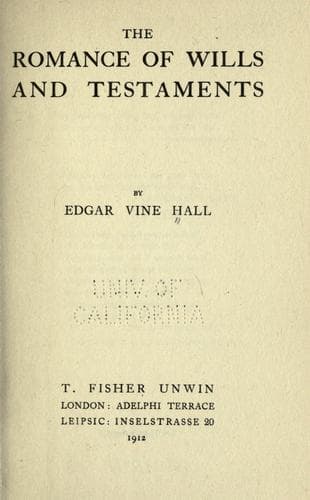
The Romance of Wills and TestamentsVine Hall, Edgar
History
The Romance of Wills and Testaments
Vine Hall, Edgar
Wills -- Great Britain -- Miscellanea
Thomas Eden, whose will is dated at Wimbledon, August 14, 1803, only
whets the appetite: “I, Thomas Eden, of sound mind and understanding,
though gradually failing in personal strength from advance in years
and what I have gone through in my life, do make this my last will and
testament.” But many curious items of biography emerge from wills.
Sometimes they are accidental or incidental; at other times the
testator makes much of them. Philip, fifth Earl of Pembroke, bequeathed
“to Thomas May, whose nose I did break at a mascarade, five shillings.”
Recently a legacy was left to one whom the testator had nearly burned
to death, another to one whom a testator had saved from drowning. “I
have been very unfortunate,” wrote a lady lately deceased. “I thought
to have a companion for the rest of my days by remarrying, but am once
more stranded and alone.”
Sir John Gayer, an illustrious seventeenth-century citizen of London,
is still remembered in an annual sermon at St. Katharine Cree,
Leadenhall Street, preached by direction of his will in commemoration
of his escape from a lion on the coast of Africa. Ezekiel Nash (will
dated March 27, 1800) left a charitable legacy for his preservation
in an engagement with a French frigate on March the 8th, 1762. A late
manager to a shipping company directed that on his tomb should be
inscribed the words:
“Let on his soul kind judgment fall,
Who did his best for one and all,”
and the following summary of his achievements: “He helped to change
paddle tugs to screw, to initiate high pressure and twin screws for
ocean-going steamers, to introduce the Steam line Conference with
the rebate system, and to start the Shipping Federation, the London
Shipping Exchange, and the British Empire League.”
Richard Forster, in his will dated November 15, 1728, opens with some
remarks on the Church and his position therein. “In the name of God
Amen. I Richard Forster, an unworthy minister of Jesus Christ, advanced
into the order of Christian priesthood according to the usage of the
Church of England, the soundest and best constituted part of the
Catholic Church, (a great number of whose parochial clergy have been
unhappily deprived of a great part of their revenues by the injurious
appropriation of tythes glebes and parsonage houses under the iniquity
of Popery,) and intending to spend the remainder of my days in the
communion and service of this Church, having by the providence of God
and the kindness of my friends been first promoted to the Rectory of
Beckly, in Sussex, and after to that of Crundale, in Kent, and lastly
to the Vicarage of Eastchurch, in Sheppey, (the defects of my duty
in all which parishes I pray God of His infinite mercy to pardon,)
and being advanced into the seventy-eighth year of my age by the
distinguishing favour of God with a sound mind and memory, though with
a weak body, I do make and ordain this my last will and testament.”
Public-domain text, read in full here on John Shaqi.
Reviews
Reviews
No reviews yet
Be the first to share your thoughts on this work.
Join the Discussion
Join the discussion
Sign in to leave a comment or review.
Sign InorCreate an account