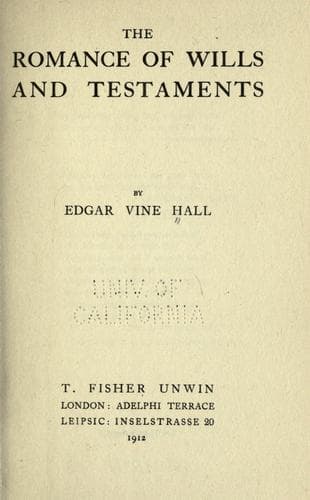
The Romance of Wills and TestamentsVine Hall, Edgar
History
The Romance of Wills and Testaments
Vine Hall, Edgar
Wills -- Great Britain -- Miscellanea
There is a tale told in Wales of a certain Sion Kent, who agreed with
the Devil to surrender to him body and soul whether he were buried
in or out of the Church. But, directing that his body should be laid
beneath the church wall, he evaded the compact. It is not often that
funeral directions have such eternal issues hanging upon them, but
frequently in wills they are given due or elaborate consideration.
“True it is,” says Fuller, “bodies flung in a bog will not stick there
at the day of judgment; cast into a wood, will find out the way;
thrown into a dungeon, will have free egress; left on the highway, are
still in the ready road to the resurrection. Yet seeing they are the
tabernacles of the soul, yea, the temples of the Holy Ghost, the Jews
justly began, the Christians commendably continue, the custom of their
solemn interment.”
Directions for the disposal of the body, and for the ceremony that
shall attend it, are of outstanding interest both for historical and
psychological reasons. As one peruses them there rise in the mind
innumerable thoughts and fancies of sad or humorous import. Every
phase of human nature is illustrated from pompous pride to lowliest
humility, from pious reverence to vulgar unconventionality, from love
of lamentation and display to hatred of mourning and show. Between the
hours of death and of burial seem to cluster many of man’s most quaint
ideas; here lies a harvest-ground for the student, and in the records
of wills rich treasures may be discovered.
Perhaps few scenes of pageantry will live in the memory more than
the funeral procession of Henry V., at Fulham, with its multitudes
of lights and figures solemnly moving through the dusk. Such a
reconstruction of the past, with its Catholic rites and ritual, its
appeal to religious emotion, illustrates the picturesque scenes and
ceremonies that lie behind the words of a will. Sometimes these
directions are given at great length and with lavish elaboration. But
not all can command magnificence in death, and the will of Henry VII.’s
tailor may be quoted as typical of the common sort.
Public-domain text, read in full here on John Shaqi.
Reviews
Reviews
No reviews yet
Be the first to share your thoughts on this work.
Elsewhere in the archive
Join the Discussion
Join the discussion
Sign in to leave a comment or review.
Sign InorCreate an account