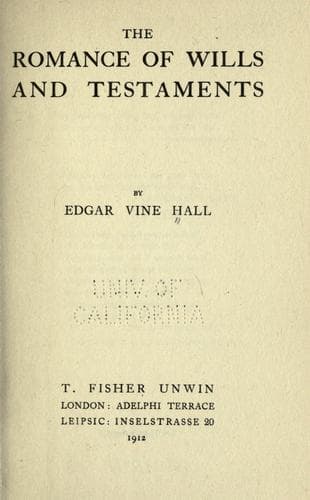
The Romance of Wills and TestamentsVine Hall, Edgar
History
The Romance of Wills and Testaments
Vine Hall, Edgar
Wills -- Great Britain -- Miscellanea
“In the name of God, Amen. The IIIIth day of the month of March, the
year of our Lord God 1503, and the XIXth year of the reign of King
Henry VIIth, I George Lovekyn, citizen of London, and tailor to our
said sovereign lord the King, being whole of mind and in good memory,
thanked be Almighty Jesu, make ordain and dispose this my present
testament and last will in manner and form ensuing, that is to wit:
First I bequeath and commend my soul to Almighty God my Maker and
Saviour and to His blessed Mother, our Lady Saint Mary the Virgin, and
to Saint George the holy martyr, and to all the holy company of heaven,
and my body to be buried in the parish Church of St. Mary Wolnoth in
Lombard Street of London afore the font there under the chapel of St.
George by me there late made, that is to say in or by the burying place
of Jane my first wife which lieth there buried, on whom Jesu have
mercy. And I will that I have at my funeral XVI torches burning to
be borne and holden by poor men to bring me to my burying place. And
I will and desire if it conveniently may be that the four orders of
friars mendicant of London shall accompany my body to the said burying
place....”
It is said that St. Swithun, when he died in 862, on his death-bed
ordered his monks to inter him not in a stately shrine, but in a
“mean place outside the door, where the foot of the passer-by might
tread, and the rain water his grave.” To be beneath the feet of priest
or worshipper was not an uncommon wish, and probably, in many cases
at least, was a desire for remembrance as much as, or more than, a
symbol of humility. Thus Gilbert Carleton, Vicar of Farningham in
1503, wishes “to be buried in the Parish Church of Farningham in
one of two places as can be thought most convenient by my friends,
either before the high altar in the chancel there, so that my feet
may be under the priest’s feet standing at mass, or else under the
step coming in at the Church door, so that every creature coming in at
the same door may tread upon my burial.” Similarly Richard-sans-Peur,
Duke of Normandy: “Je veulx estre enseveli devant l’huys de l’église,
afin d’estre conculqué de tous les entrans dans l’église.” Another
favourite place is that chosen by Agnes Spicer (1410): “My body to be
buried in the Church of St. Austin’s under the bell ropes.” So Ludovic
Stuart, Lord of Aubigny (1665), desired his “corpse to be buried and
interred without opening it in the Church of the Reverend Fathers the
Carthusians in this City of Paris just under the cord wherewith they
ring the bell for the divine service, without any pomp, ceremonies,
and hanging up of mourning tapestries in the Church; and that upon his
grave there be laid a stone of just proportion, whereon they will write
his name and quality of Great Almoner without adding anything else.”
Public-domain text, read in full here on John Shaqi.
Reviews
Reviews
No reviews yet
Be the first to share your thoughts on this work.
Elsewhere in the archive
Join the Discussion
Join the discussion
Sign in to leave a comment or review.
Sign InorCreate an account