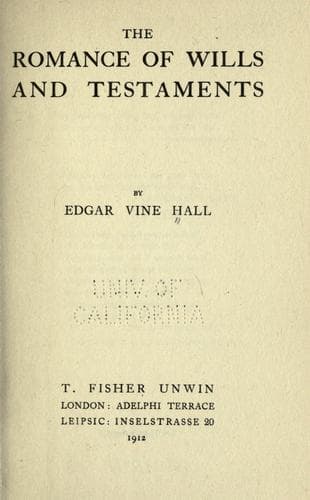
The Romance of Wills and TestamentsVine Hall, Edgar
History
The Romance of Wills and Testaments
Vine Hall, Edgar
Wills -- Great Britain -- Miscellanea
A late Bishop Suffragan of Shrewsbury directed that he should be
buried in the simplest possible manner, in an earthen grave which was
to be covered with a low plinth bearing the words, “Not worthy of the
least of all the mercies which Thou hast shewed unto Thy servant,” and
earnestly entreated that no attempt should be made to raise any public
memorial in his honour. Father Tyrrell, in a document dated January 1,
1909, wished nothing to be written on his grave except his name and the
statement that he was a Catholic priest, with the addition only of the
emblem of the Chalice and the Host.
Less simple in the desire for simplicity were the instructions of a
solicitor, who directed that his remains should be cremated and the
ashes scattered in some plantation for restoration to the world which
he had “found so delightful”; that his funeral should be conducted in
the most unostentatious, private, and, indeed, secret manner, without
advertisement or invitations to attend, and that no gravestone should
be erected.
At the particular desire of Edward Nokes, a miser of Hornchurch,
whose niggardliness was extended to his funeral arrangements, none
who followed him to the grave was in mourning, but each follower
appeared in striking costume and the undertaker in blue coat and
scarlet waistcoat. Such is the lamentable antithesis of a desire which
is sometimes expressed, and with which it is easy to sympathise, that
no black garments shall be worn. It is a desire which is, perhaps,
increasingly common, though in the seventeenth century there are
such conspicuous passages as Jeremy Taylor’s protest against undue
lamentation and Bacon’s Essay “Of Death.” Sir John Monson (who is
referred to on p. 202) makes it his last request that his wife and
relations will not think that a loss to them which will be so great
an improvement of his joy and happiness, and not make his crown their
cross, but enjoy themselves and those earthly comforts God shall still
bless them with in an holy submission and cheerfulness. Perhaps the
ideal method in this question, difficult because of prejudice and
custom, was attained by Christina Rossetti, who, at her grandmother’s
death, was without black clothes, but wrote that she had nevertheless
“managed to put on nothing contrary to mourning.”
Recently a testatrix desired her body to be buried in quicklime in an
ordinary grave, not a walled grave or a vault, and directed especially
that no mourning should be worn and that the funeral service should
be as cheerful as possible: another that her children should wear as
little black as possible, and not shut themselves up, but go out among
friends and to places of amusement. “I am not afraid of them forgetting
me, but I want them to be happy.”
Public-domain text, read in full here on John Shaqi.
Reviews
Reviews
No reviews yet
Be the first to share your thoughts on this work.
Elsewhere in the archive
Join the Discussion
Join the discussion
Sign in to leave a comment or review.
Sign InorCreate an account