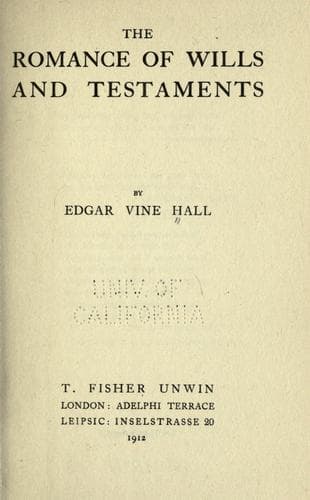
The Romance of Wills and TestamentsVine Hall, Edgar
History
The Romance of Wills and Testaments
Vine Hall, Edgar
Wills -- Great Britain -- Miscellanea
“Let me be placed in my coffin,” wrote an artist in Paris, “as quickly
as possible after my death, and let nobody outside the household be
admitted to my death chamber before I am placed in the coffin. In a
word I do not wish anybody to attend through curiosity to see how I
look. Let no portrait or photograph be made of my corpse, and let me be
buried in the shortest time possible. And do not weep for me. I have
lived a life happy enough; the aim of my life was my painting, and I
gave all of which I was capable. I might have lived another twenty
years, but should not have progressed any more, so what would have
been the good? And how content I should be if no one wears the marks
of mourning. I always had a horror of this show, so if you cannot do
otherwise, then wear the least of it possible.”
Thought and care for those who are to “have the pleasure of surviving”
add here and there pathetic touches. Mary Horne in 1784 wrote an
informal will, of which this is the dominant note. “My dear Sister,
being very desirous of giving you as little trouble at my death as
possible shall make no will, being well assured you’ll strictly observe
and comply with this my last request, which is that I may be decently
interred according to the enclosed directions.... My desire is that
I may be kept as long as possible before I am buried, and to lay as
near my dear father and mother in the parish church of Swindon as
conveniently to be done, and if not attended with much trouble. I would
have no shroud but combed wool: to be carried by six poor men of the
town, and to each half a guinea given and a strong pair of gloves: the
pall flung over me which belongs to the clerk, and no one invited to
the funeral, but a pair of the best kid gloves sent to all in the town
who I visited.... To those who have the trouble of laying me out and
being in the room with me after I am dead a guinea to each and a good
pair of gloves.”
As this was dated September 29, 1784, and proved on October 6th, the
good lady must have written it within a day or two or an hour or two
of death: it is legitimate to believe that she was as loath to give
trouble in her life as after death, and that “all in the town whom she
visited” were her mourners.
Public-domain text, read in full here on John Shaqi.
Reviews
Reviews
No reviews yet
Be the first to share your thoughts on this work.
Elsewhere in the archive
Join the Discussion
Join the discussion
Sign in to leave a comment or review.
Sign InorCreate an account