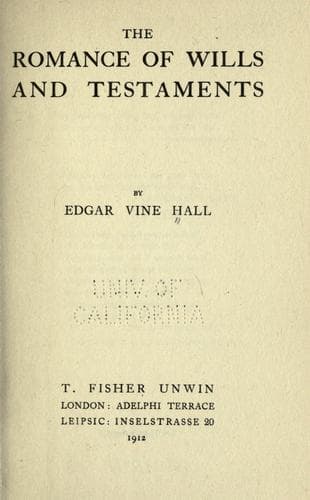
The Romance of Wills and TestamentsVine Hall, Edgar
History
The Romance of Wills and Testaments
Vine Hall, Edgar
Wills -- Great Britain -- Miscellanea
Dorcas Hutchinson, of St. Anne, Soho (will proved June 3, 1761), was
content with a less drastic method. “I mean by my desire above written
not to be enclosed in any coffin whatever within seven days after my
decease; that my corpse be laid upon a bed during that time, and may
not be put into any covered coffin until the eighth day. My will is
that Edward Havel my present servant may take care that the above
request is literally complied with, and for that purpose may stay in
the house till I am buried, and upon his so doing I do bequeath him the
sum of £50.”
For such a method there is much to be said, if after apparent death a
prolongation of life be desired, but the method is unfortunately not
conclusive. “Everybody has heard,” writes John Timbs, “of the lady
who was buried, being supposed dead, and who bearing with her to the
tomb, on her finger, a ring of rare price, this was the means of her
being rescued from her charnel prison-house. A butler in the family of
the lady, having his cupidity excited, entered the vault at midnight
in order to possess himself of the ring, and in removing it from the
finger the body was restored to consciousness and made her way in her
grave-clothes to her mansion. She lived many years afterwards before
she was finally consigned to the vault.”
On Saturday, October 29, 1808, Elizabeth Emma Thomas was buried at
Islington, and on Monday this inscription was raised:—
“In Memory Of
Mrs. Elizabeth Emma Thomas
Who died the 28th October, 1808,
Aged 27 years.
She had no fault save what travellers give the moon:
Her light was lovely, but she died too soon.”
Suspicion was aroused from the rapidity of her burial, the grave
opened, and the body removed into the church for inspection. Suspicion
seemed justified when a large wire pin was found thrust through her
left side and fixed in her heart. But it appeared from the evidence
that this was done at her own desire, to prevent the possibility of
being buried alive, and the jury returned a verdict accordingly: “Died
by the visitation of God.”
But the preceding is a digression on the way to simplicity. With such
an expression as “I commit ... my body to the deep or any convenient
place, it’s immaterial where,” we reach down to the minimum, and must
ascend again. “To them,” says Jeremy Taylor, “it is all one, whether
they be carried forth upon a chariot or a wooden bier; whether they
rot in the air or on the earth; whether they be devoured by fishes or
by worms, by birds or by sepulchral dogs, by water or by fire, or by
delay”; but man is often in nothing so eccentric as in his desires for
the disposal of his remains, or in the accompaniments and accoutrements
he asks for his obsequies.
Public-domain text, read in full here on John Shaqi.
Reviews
Reviews
No reviews yet
Be the first to share your thoughts on this work.
Elsewhere in the archive
Join the Discussion
Join the discussion
Sign in to leave a comment or review.
Sign InorCreate an account