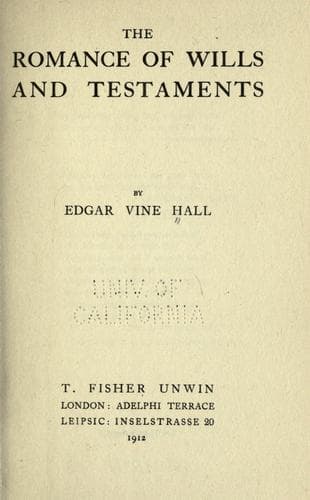
The Romance of Wills and TestamentsVine Hall, Edgar
History
The Romance of Wills and Testaments
Vine Hall, Edgar
Wills -- Great Britain -- Miscellanea
Mary Horne, it will be noticed, wished to be kept as long as possible
before her burial. She does not give a reason, but it was presumably
to lessen the risk of premature burial, the possibility of which
haunts many minds. Seven years before her death Dr. William Hawes had
published his “Address on Premature Death, and Premature Interment,”
and still to-day the subject is one of importance, as the Society for
the Prevention of Premature Burial can testify. Recently a testator
expressed a wish either to be cremated or that his heart should be
pierced, as “I feel assured that many persons are buried alive.” Now
and then sensational stories appear, as of rappings in a coffin or
of the revival of one about to be interred. “All I recommend,” said
James Clegg, “is not to be lain under ground alive,” and what he
recommends is often anxiously striven against. Such efforts were made
by Ann West (ob. 1803) who once was nearly buried alive, by directing
that she should be buried in a coffin without a lid, and that a hole
should be left in the brickwork of her vault. It was even said that she
bequeathed her fortune to a servant on condition that he should place
bread and water on her coffin for a year in case she should revive and
need them. But perhaps all was not well at last, for her ghost was said
to haunt the neighbourhood.
A similar tale is told of a Manchester lady, a Miss Bexwick or Beswick,
who died about the middle of the eighteenth century, and devised an
estate to her doctor and others, on condition that the doctor paid
her a morning visit for twelve months after her death. To fulfil the
conditions it was necessary to embalm her body, and the doctor resided
in the house to pay the mummy his daily call.
Horatio Mucklow, of Highbury (ob. July 27, 1816), bequeathed a legacy
to Powell the parish clerk, on condition that he would see his head
severed from his body previous to burial, and Thomas Trigge, of St.
George, Southwark (will dated February 24, 1755, and proved November
25, 1784), directed that before he was shut up in his coffin a surgeon
should give him such a wound as would prove immediately fatal were he
alive. Such drastic methods are not uncommon to-day. The late Lord
Burton wrote: “I desire that before my body be placed in the coffin
the spine and spinal marrow of the neck shall be completely severed
by a competent surgeon and the heart removed and placed in a separate
vessel, to be enclosed in the coffin,” and presumably the risk of
premature burial was in his mind. “I have a great horror of being
buried alive,” wrote a lady in her will, “therefore I wish my finger to
be cut,” and she bequeathed £10 to the doctor performing such service.
Another ordered a doctor to “thrust a dagger through my heart three
times to make sure I am dead.” Better thus than to be buried alive:
such a stuffy death, as Yum-Yum says in “The Mikado.”
Public-domain text, read in full here on John Shaqi.
Reviews
Reviews
No reviews yet
Be the first to share your thoughts on this work.
Elsewhere in the archive
Join the Discussion
Join the discussion
Sign in to leave a comment or review.
Sign InorCreate an account