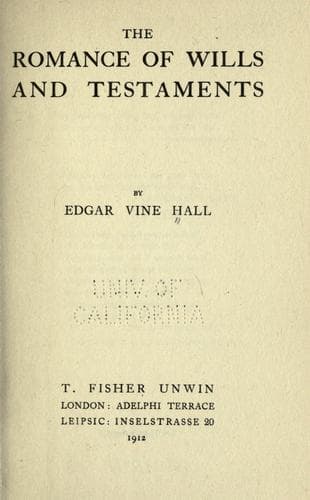
The Romance of Wills and TestamentsVine Hall, Edgar
History
The Romance of Wills and Testaments
Vine Hall, Edgar
Wills -- Great Britain -- Miscellanea
As an example from Catholic England the following is typical: “In the
name of God, Amen. I Dame Anne Haydon, widow, being in my whole mind
and of good memory the XVIIth day of December in the year of our Lord
God 1509, and in the first year of King Henry the VIIIth, make this my
testament and last will in manner and form following, that is to say,
First, gracious Jesu, I as a sinful creature by reason of my demerits
not worthy to be accepted into the holy company of heaven to continue
in that holy place, Lord, without Thy great and large mercy and grace,
(the which through Thy Passion to every Christian man meekly and lowly
asking graciously grantest): Wherefore I now being in my full and whole
mind and in perfect love and charity, and in steadfast faith, ask and
cry Thee, Jesu, our Lady Saint Mary Thy blessed Mother, all the holy
company of heaven, and all the world, mercy, trusting verily that
through Thy Passion and with the succour and relief of that gracious
Lady Thy Mother and Maid to sinners to her calling for help of her
great pity greatly and very comfortable: Wherefore, blessed Jesu, I
commit my soul to Thee and to Thy blessed Mother our Lady Saint Mary
and to all saints of heaven through the mean and help of St. John
Baptist, St. Anne, St. Mary Magdalen and St. Christopher mine avouers.
And my sinful body to be buried in the Chapel of St. Luke in the
Cathedral Church of the Holy Trinity of Norwich, if I die in Norwich or
in Norfolk.”
Such is a common form, diversified by individual and expressive
variations, of wills in those days. The Reformation changed the form
but not the spirit of these avowals. “I render back,” wrote Sarah Ward
in 1662, “into the hands of my God and Creator the soul I received from
Him, humbly desiring His fatherly goodness for the infinite merit of
His Son Jesus Christ and His all-sufficient Passion, (on which I wholly
rely, disclaiming any confidence in saints or angels,) that He would
make it partaker of eternal life and a citizen of His heavenly Kingdom.
My body I bequeath to the earth whence it was taken, firmly believing
the resurrection of the dead, and that I shall rise again in the last
day, and see God in my flesh with the self-same eyes I now use and no
other. The manner of interring it I leave wholly to my executors ...
being no farther solicitous for so contemptible a remnant than as it is
yet the hospital of a reasonable soul.”
Public-domain text, read in full here on John Shaqi.
Reviews
Reviews
No reviews yet
Be the first to share your thoughts on this work.
Join the Discussion
Join the discussion
Sign in to leave a comment or review.
Sign InorCreate an account