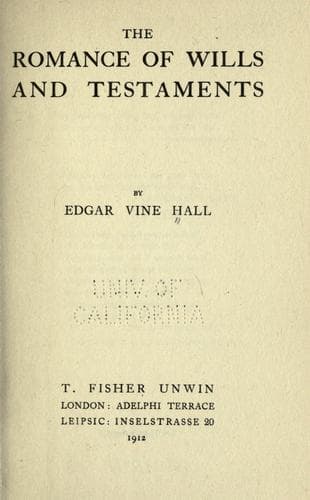
The Romance of Wills and TestamentsVine Hall, Edgar
History
The Romance of Wills and Testaments
Vine Hall, Edgar
Wills -- Great Britain -- Miscellanea
After the plague, the fire. That naturally does not loom large in
wills, but references may be found. Thus Edmund Calamy, “minister of
the gospel,” whose will was dated October 4, 1666, and proved November
14th, gave to his “dear and loving wife,” Anne Calamy, “all the ground
whereon my house stood which was lately burned down, called or known
by the name and sign of the Rose, and was situate and being in St.
Nicholas Lane, London, and all the timber and all the materials which
did belong to the same that yet remain unburned, (if any be).” “And as
for the manner of my burial, my desire is to be buried in the ruins of
Aldermanbury Church; and in regard of my many children my will is that,
besides mourning unto my relations, nothing be given at my funeral, not
doubting that my friends and acquaintances, who shall come to perform
their last office of love to me, will not come out of expectation of
anything, but out of pure love and respect to the memory of their
deceased friend.” This Edmund Calamy was committed to Newgate on
January 6, 1663, the first Nonconformist who suffered for disobedience
to the Act of Uniformity. Set free by order of the King, he was driven
through the ruins of London, and the sight, it is said, broke his
heart. He died on October 29, 1666, and was buried in the ruins of his
church, “as near to the place where his pulpit had stood as they could
guess.”
Lastly, Thomes Rich (dated July 31, 1672), devised a messuage and
premises in Lime Street, St. Andrew Undershaft, the rents to be
distributed as to 40s. yearly to the minister of the parish to preach
there two sermons, one on New Year’s Day, the other on the third
Tuesday in September, in thankfulness to God for the preservation of
the parish from the Fire.
VII
Appended to the will of Thomas Appletree, a lengthy document, is the
following memorandum: “Be it remembered that on Saturday the one and
thirtieth day of March last past before the date hereof (April 27th,
1666) Thomas Appletree, of Dadington, ... Esq., lying sick in his bed,
(his brother William Appletree of Dadington aforesaid, Gentleman,
being by his bedside, and Lettice Appletree daughter of the said
Thomas Appletree being in the same chamber,) his said brother William
Appletree said thus unto him:—Brother I know you have made your will,
pray where is it? His answer was:—It is in the little trunk at my bed’s
feet.”
Public-domain text, read in full here on John Shaqi.
Reviews
Reviews
No reviews yet
Be the first to share your thoughts on this work.
Join the Discussion
Join the discussion
Sign in to leave a comment or review.
Sign InorCreate an account