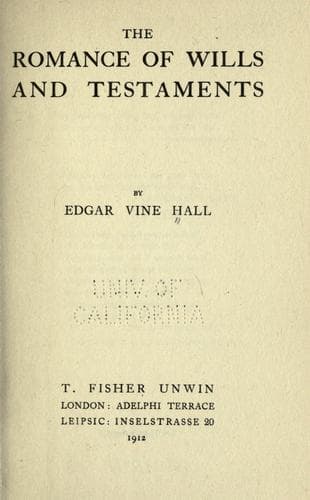
The Romance of Wills and TestamentsVine Hall, Edgar
History
The Romance of Wills and Testaments
Vine Hall, Edgar
Wills -- Great Britain -- Miscellanea
Of all acts which exasperate the human sense of piety and justice,
perhaps the most exasperating is the destruction of a will after the
death of the deceased. The destruction of the will of George I. by his
son George II. is famous in history, but in view of evidence recently
adduced we need not enlarge upon the traditional interpretation. Some
wills, indeed, are better destroyed.
For the purposes of poetry, drama, and fiction, this theme is obvious
but not negligible. There is a remarkable similarity between the
atmosphere of Sir Arthur Pinero’s dramas and George Crabbe’s poems.
Each, too, has chosen in one instance the criminal destruction of a
will to build upon, and while Crabbe’s poem, “The Will,” is slight and
Pinero’s drama, “The Thunderbolt,” is subtle, yet poet and dramatist
are worth comparing.
In “The Will” a father wishes to disinherit his unworthy son and leave
his estate to a worthy friend. The friend dissuades him, but keeps the
first will in case the father should revive it.
“The Will in hand, the Father musing stood,
Then gravely answered, ‘Your advice is good;
Yet take the paper, and in safety keep;
I’ll make another will before I sleep,
But if I hear of some atrocious deed,
That deed I’ll burn, and yours will then succeed.
Two thousand I bequeath you. No reproof!
And there are small bequests—he’ll have enough;
For if he wastes, he would with all be poor,
And if he wastes not, he will need no more.’
The Friends then parted: this the Will possess’d,
And that another made—so things had rest.”
Until the father died.
Public-domain text, read in full here on John Shaqi.
Reviews
Reviews
No reviews yet
Be the first to share your thoughts on this work.
Join the Discussion
Join the discussion
Sign in to leave a comment or review.
Sign InorCreate an account