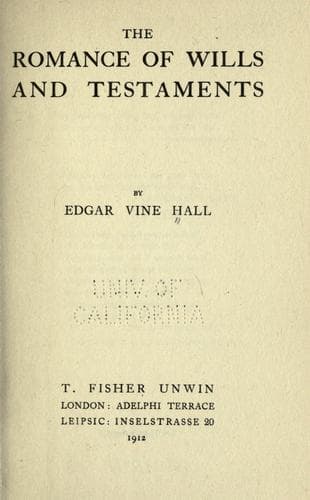
The Romance of Wills and TestamentsVine Hall, Edgar
History
The Romance of Wills and Testaments
Vine Hall, Edgar
Wills -- Great Britain -- Miscellanea
Bishops and kings of old were next to none in the vigour of their
language. Theodred, Bishop of London in Edgar’s reign, is aggressively
violent: “And whosoever takes from my testament, may God take him from
the Kingdom of Heaven, unless he amend it before his death.” In the
same spirit, if with less directness, Henry VI. requires the fulfilment
of his will: “And that this my said will in every point before
rehearsed may the more effectually be executed ... I ... not only pray
and desire, but also exhort in Christ require and charge, all and every
of my said feoffees, my executors and surveyor or surveyors, in virtue
of the aspersion of Christ’s blessed blood and of His painful passion
that they having God and mine intention before their eyes, not letting
for dread or favour of any person living of what estate degree or
condition that he be, truly faithfully and diligently execute my same
will and every part thereof, as they will answer before the blessed and
dreadful visage of our Lord Jesu in His most fearful and last doom,
when every man shall most strictly be examined and deemed after his
demerits. And, furthermore, for the more sure accomplishment of this
my said will, I in the most entire and most fervent wise pray my said
heirs and successors and every one of them, that they show themselves
well willing faithful and tender lovers of my desire in this behalf;
and in the bowels of Christ our altogether just and strict judge
exhort them to remember the terrible comminations and full fearful
imprecations of Holy Scripture against the breakers of the law of God,
and the letters of good and holy works.”
If Bishops and Kings must write with such vehemence, how shall the
humble citizen fare? The possibility of the deceased’s wishes being
neglected or overridden was so real that old writers advise the
charitable to exercise their charity in their lifetime, and not to
trust to executors or friends. Their faithlessness had even passed
into a proverb: “three executors make three thieves.” Thus John Stow,
in his “Survey of London,” remarks how often wills were proved but not
performed: “Thus much for famous citizens have I noted their charitable
actions, for the most part done by them in their lifetime. The residue
left in trust to their executors. I have known some of them hardly (or
never) performed, wherefore I wish men to make their own hands their
executors, and their eyes their overseers, not forgetting the old
proverb:
“Women be forgetful, children be unkind,
Executors be covetous, and take what they find.
If any body ask where the dead’s goods became,
They answer, So God help me and holydom, he died a poor man.”
Public-domain text, read in full here on John Shaqi.
Reviews
Reviews
No reviews yet
Be the first to share your thoughts on this work.
Join the Discussion
Join the discussion
Sign in to leave a comment or review.
Sign InorCreate an account