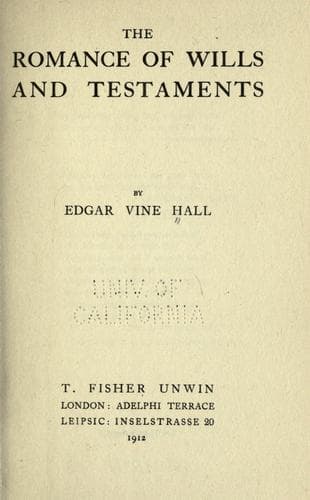
The Romance of Wills and TestamentsVine Hall, Edgar
History
The Romance of Wills and Testaments
Vine Hall, Edgar
Wills -- Great Britain -- Miscellanea
The words of the writer are peculiarly apt to describe the charm of
wills. But the older we grow, the more do men and women, by reason
only of their humanity, absorb our interest. In wills human nature is
most vividly and variously displayed. In wills the dead speak, and
in a manner live again. The poor and the rich, men learned and men
illiterate, all alike have made interesting wills. In some cases humour
and pathos are more unconscious, in others opportunity for effect is
greater; but in wills of every class, and of every age or form, there
is much worthy of remark.
Historically they are invaluable records. In them are reflected all
social, political, and religious revolutions. By them the history of
families or places is preserved and illuminated. As long ago as the
sixteenth century John Stow realised their value, and often referred
to them in his “Survey of London.” No local record to-day would be
complete without the wills of its worthies.
There is unrivalled scope for the imagination in perusing the last
dispositions of the dead. How easy it is, with these documents before
us, to picture the figures of each generation; the fervent Catholic
of the fifteenth century, the pious benefactor of the sixteenth, the
“heroic English gentleman” of the seventeenth, the Whig or Tory of
the eighteenth; and at all times the homely or eccentric testator who
allows many a secret comedy or tragedy to appear, many a prejudice
or foible, many a sentiment of resignation or revolt. Some give the
impression of peevishness and irresolution, of spite or hate; some of
sentimental or petty desires; some of serene care for the future, of
dignity and calm.
Little, indeed, in all literature is more arresting than the revelation
of personality, the unveiling of intimacies that are seldom seen: in
wills these intimacies occur, the veil is withdrawn, in a manner that
elsewhere can rarely be observed. Whether they be light or serious,
amusing or tragic, the occurrence of such vivid traits in a will gives
them a character peculiarly humorous or correspondingly sad. The
idiosyncrasy is magnified, the bias more distorted, when placed in such
a setting.
Public-domain text, read in full here on John Shaqi.
Reviews
Reviews
No reviews yet
Be the first to share your thoughts on this work.
Join the Discussion
Join the discussion
Sign in to leave a comment or review.
Sign InorCreate an account