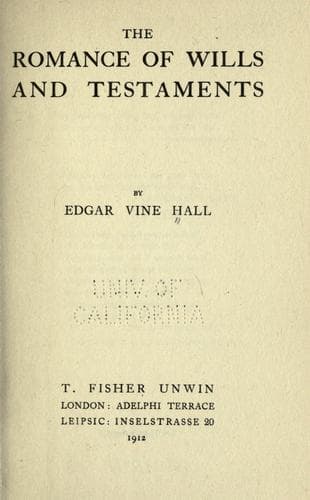
The Romance of Wills and TestamentsVine Hall, Edgar
History
The Romance of Wills and Testaments
Vine Hall, Edgar
Wills -- Great Britain -- Miscellanea
After various bequests, including the interesting one of $100 “unto
the redemption of the poor English captives in Constantinople,” the
will of James Peckett, merchant, made in Smyrna, May 3, 1634, breaks
off suddenly, and we read: “The aforegoing is as much as was delivered
by Mr. James Peckett, who afterwards falling weaker in body and his
memory decaying, it was propounded unto him whom he should make choice
of for to be his executors in trust, whereupon he nominated Mr. Richard
Chambers of London, Merchant, and Mr. Lawrence Greene, Consul for
the English nation in Smyrna, and afterwards for his overseers, not
knowing who to nominate through his weakness there was propounded unto
him whether he would accept of Mr. Rainsbrow and Mr. Thomas Moody of
London, merchants: unto the which he answered ‘Yea.’”
This will is, therefore, a mingling of the written and unwritten
testament. The nuncupative will, the will by word of mouth, was common
in former times; but since the stricter methods of the Wills Act, 1837,
it has been mainly in abeyance. Attempts are still made from time to
time to establish the words of dying men. A recent action in the Court,
to legalise some strangely made codicils, reminds us of James Peckett’s
acquiescence and of older methods. “Don’t you want to leave something
to me?” the testator was asked. He answered, “Yes,” the question was
put, “How much?” and a codicil straightway prepared.
The prevalence of such wills, without even the necessity of a written
record signed by the testator, must have led to much abuse. But not
always were testators so complaisant. Roger Potter, of Mildenhill,
Suffolk, a bachelor “in the time of his last sickness (viz.) upon or
about the 12th day of November 1664, did make and declare his last
will and testament nuncupative as followeth. He being moved to make
his will, he answered ‘With all my heart.’ And then, being asked or
demanded whom he would make executor, he replied ‘Executrix,’ and named
Mall, meaning as was understood by those present Mary Potter, his
brother’s grandchild, whom he especially regarded. And then being moved
what he would give to any of his friends, he expressed an unwillingness
to do any more, saying ‘Why do you urge me?’” So, too, Reginald Greene
“on a Sunday, being the fifth day of July A.D. 1635, ... being then
very sick but of good and perfect mind and memory, with an intent to
make his last will and testament nuncupative spake these words, or the
like in effect, as followeth, viz.: He gave all his goods chattels and
debts unto his cousin John Greene ... and his son John Greene. Judith
Springatt being present did desire that she might be remembered in his
will and to have a legacy therein: he replied ‘No, no,’ and said he had
been always beholding to his cousin John Greene and that he and his
boy, meaning his said son John Greene, should have all that he had.”
Public-domain text, read in full here on John Shaqi.
Reviews
Reviews
No reviews yet
Be the first to share your thoughts on this work.
Elsewhere in the archive
Join the Discussion
Join the discussion
Sign in to leave a comment or review.
Sign InorCreate an account