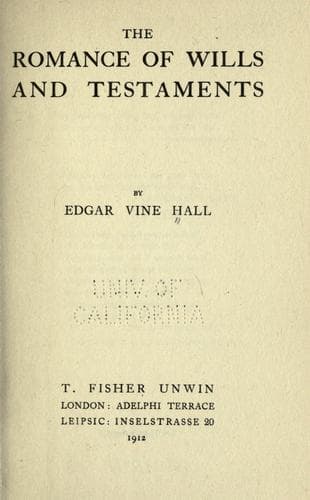
The Romance of Wills and TestamentsVine Hall, Edgar
History
The Romance of Wills and Testaments
Vine Hall, Edgar
Wills -- Great Britain -- Miscellanea
How often a dying man may have fallen a prey to the designs of friends
or foes one could not hazard a guess: it is remarkable, on the other
hand, what powers of resistance a man in his last sickness may show.
Two instances have just been given, but still more interesting is the
final will of Henry Akerman, a victim of the plague. What perturbation
of mind for a dying man to suffer! “Memorandum that at or upon the
VIth day of August A.D. 1603, and between five and six of the clock in
the afternoon of the same day, or thereabouts, Henry Akerman, of the
parish of St. Giles Without Cripplegate, London, being weak in body and
visited with the sickness, but of perfect mind and memory, did, with
an intent absolutely to revoke all former wills before by him made,
make and declare his last will and testament nuncupative in manner and
form and by the words following, or the like in effect, viz.: ‘Whereas
this day I did unadvisedly make a will in writing by the procurement
of some of my friends, and named therein John Dardes and Jarvice Pitt
to be my executors, I do now upon better consideration clean revoke
that will, for that I distrust and find that I had done my children
wrong thereby. And therefore now I make Mary my well beloved wife my
executrix. And I give will and bequeath my goods and chattels, and
whatsoever else hath pleased God to bless me withal, to be equally
divided betwixt my said wife and my children according to the custom of
the City of London’: and these or the like words in effect he spake in
the hearing of divers credible witnesses.”
The temptation to postpone a will, to refuse to look death in the face,
must have been great when a few dying words were valid. To some how
hard is the Horatian theme: _divitiis potietur heres_!
“I’m growing old, and hence ere long shall fare,
How I should love to be my only heir,”
a Hebrew epigrammatist makes a miser say. Pope depicts the miser
clinging at the last moment to his lands and his cash, only with his
latest breath, reluctantly, making some disposition of his goods.
“‘I give and I devise’ (old Euclio said,
And sighed), ‘my lands and tenements to Ned.’
‘Your money, sir?’ ‘My money, sir, what, all?
Why,—if I must’—(then wept) ‘I give it Paul.’
‘The manor, sir?’—‘The manor! hold,’ he cried,
‘Not that,—I cannot part with that’—and died.”
Public-domain text, read in full here on John Shaqi.
Reviews
Reviews
No reviews yet
Be the first to share your thoughts on this work.
Elsewhere in the archive
Join the Discussion
Join the discussion
Sign in to leave a comment or review.
Sign InorCreate an account