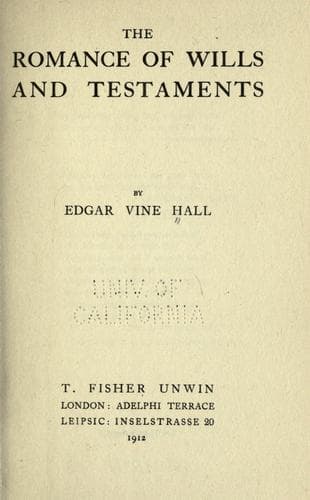
The Romance of Wills and TestamentsVine Hall, Edgar
History
The Romance of Wills and Testaments
Vine Hall, Edgar
Wills -- Great Britain -- Miscellanea
Nuncupative wills are, in fact, often of a vividness as keen as Pope’s
example. The friends, interested or otherwise, who gathered round the
testator in a moment of peril or in the hour of death, reproduced his
words or actions with quaint exactitude. Sometimes it is in times of
peril. “Memorandum that James Dixon, late mariner to His Majesty’s
ship the _Pearl_, but in His Majesty’s hired sloop the sloop _Jane_,
bachelor, deceased, did on or about the 22nd of November 1718 in the
morning of the said day, he the said James Dixon being in the hole
(_sic_) of the said sloop and then about to engage with a pirate
called the _Adventure_ sloop, did in the presence of several credible
witnesses utter and declare his last will and testament nuncupative or
by word of mouth in the words following, or to that effect: Messmate,
being going to engage which God knows whether of us shall live, but
if it please God it is my misfortune to die first, I desire that you
would take care and demand all my wages prize money and what shall
be due to me from this day, and the longest liver of us to take all;
meaning and speaking to Evender Mackever who was then his messmate on
board the said ship.... And the said sloop _Jane_ about half an hour
after engaged their enemy, and in such engagement the said James Dixon
received a shot, who immediately died.”
Such is the end of the adventurer’s life. At another time we are
present at the death-bed of the village blacksmith. Thus it is deposed
of John Silkwood, a blacksmith residing at Chartham, that he “did on
Thursday the 17th day of February, 1691 (S.A.), lying very sick in his
then dwelling-house in Chartham aforesaid of the sickness whereof he
died, being of perfect mind and memory, and having an intent to make
his will and dispose of his estate, declare the same by word of mouth
in these or the like words following, viz.: taking his wife by the
hand, and putting her wedding ring on her finger, said to her, ‘Thus we
have lived together in love, and all that I have both within doors and
without I give unto you, and make you executrix of my will.’ ...”
Nor did humble folk only thus make or amplify their wills. It is
recorded of Sir Giles Dawbeney, Knight, that on March 3, 1444, he
wrote his will, but made no disposition of the residue. “Wherefore
afterwards, that is to say the XIth day of January, the year of our
Lord 1445, at Barington, to the said Sir Giles lying in his sickness,
whereof he died soon after the same day, Sir Robert Wilby, priest, his
ghostly father, said: ‘Sir, ye have made a testament and bequeathed
many things to divers persons, making no mention who should have the
residue of your goods that be not bequeathed; will ye vouchsafe to say
who shall have it?’ Forthwith the said knight, without any tarrying,
said: ‘My wife shall have it.’ This was his last will.”
Public-domain text, read in full here on John Shaqi.
Reviews
Reviews
No reviews yet
Be the first to share your thoughts on this work.
Elsewhere in the archive
Join the Discussion
Join the discussion
Sign in to leave a comment or review.
Sign InorCreate an account